

Gwangju as Home: Critical Language Scholarship at CNU
By Jacqueline L. Becerra ||
As summer progresses into July, a sweltering heat engulfs the lush greenery surrounding Chonnam National University (CNU), where the buzzing of dragonflies can be heard across Yongji pond, and the haze of strong sunrays reflects off the steep terrain. Even in the midst of such stifling weather, campus is bustling with students, staff, and residents. You might see several tours for visiting students in the Korean summer program, and among them will be a small group in the Critical Language Scholarship (CLS) program. I should know, this time three years ago, I was part of it, heaving in the humid summer air as the blare of a microphone guided us through the campus.
CNU is no stranger to scholarship programs, like that of the Global Korean Scholarship (GKS) program, but even for those around Gwangju, not much is known about CLS. To give a quick rundown, the scholarship is organized by the U.S. Department of State, given only to current U.S. undergraduate and graduate students to study languages deemed critical to the United States’ national security and economic prosperity.¹ Within a variety of languages, Korean holds a spot, requiring applicants to have a year of prior study. Apart from the selective ten percent acceptance, this program is known for its rigorous language study, claiming that the program is equivalent to one year of language study packed into eight weeks.¹ In essence, the scholarship is an immersive experience that promises immense language growth within the program’s duration.
When I applied for the scholarship back then, I knew that the recipients would participate in structured lectures, group excursions, and live on campus with CNU students. Yet, while this program was outlined in detail on paper, it went beyond what I imagined. As a sort of love letter for this city and a reflection on my CLS experience, now as an alumnus, I hope to encapsulate those cherished summer memories here.
Where Is Gwangju?
Since 2015, CNU has primarily hosted the CLS Korean recipients. However, three years later, CLS organized and sorted successful applicants between two program sites: Chonnam National University and Pusan National University.² After a brutal period of waiting through the initial round and semi-finalist stage for CLS, I got my acceptance email, receiving my placement in Gwangju. However, I had no idea what to expect: I didn’t know anything about Gwangju. I had been to Korea and traveled to Busan before, but never to Gwangju. And the more I asked my Korean peers about it, the less I felt I knew.
At the time, my image of Gwangju was characterized as primarily having good food and being in the countryside. Even now, when I mention that I stayed in Gwangju, the first few comments I receive are always along the lines of “What did you even do there?” or “Why Gwangju?” While I, too, began to develop those same thoughts back then, having no insider information about Gwangju, I decided to have zero expectations. I would learn what Gwangju had when I got there, and I had a whole summer to find out.
Korean for Eight Weeks
After a twelve-hour plane ride and a nearly five-hour bus ride from Incheon, we finally arrived in Gwangju. Over the next few days, we crossed CNU’s campus, took part in orientation and soon committed ourselves to the language policy: to use only our target language, Korean, during the program. While we were immersed in Korean simply by being in Korea, this pledge made us commit to maximizing our language abilities. We weren’t simply studying Korean; we were living in it. Thus, classes were fully in Korean, as were most of our interactions after that. Each CLS recipient was paired with a Korean roommate and a language partner, both being current CNU students who were assigned certain missions or tasks with us, such as visiting their families.
It was clear early on that this program was structured for language growth; for three hours every weekday, we were in the classroom studying grammar and other materials. Apart from lectures and regular exams, there were also mandatory one-on-one office hour consultations with our professors. Yet, in spite of all the intense coursework, I found that I learned more outside the classroom. Those hours in class certainly gave me the grammar patterns and lexical itenms I needed, but as I spoke every day, my crippling perfectionism subsided, and the hesitation to be wrong slowly dissipated. At last, I had found my voice, perhaps plagued by errors and awkwardness, but I was finally comfortable speaking Korean.
Three Years Later
Through the program, all of us in our cohort discovered local spots, went on excursions to different areas in Jeollanam-do, and formed lifelong bonds with each other. Thus, what I found in Gwangju was community, friendships, and my voice. CLS allowed me the opportunity to fully immerse myself in Korean culture, and specifically that of Gwangju’s. And regardless of how short the program was, I became fond of this city’s rich history, the strength and kindness of its people, and indeed its exquisite food. While I first had uncertainty, I took the leap to come here and was given a temporary home to always return to.
“That summer was transformative for all of us at the cohort.”
That summer was transformative for all of us in the cohort. Despite it now being a memory from three years ago, many of us continue to study the language, with some of us working in Korea or studying here. We’ve also kept in contact with our language partners and roommates, retaining the ties we have to this city. As for me, though I live near Seoul, I always find myself coming back to Gwangju whenever I can. People might say there’s not much to do here, and while it is no megacity like Seoul, it has its own charm; you just need to keep an open mind and be willing to explore what it has to offer.
This year’s cohort, having arrived in mid-June, will continue the program through next month until August 14. For more information on the CLS Korean program, refer to www.clscholarship. org/languages/korean.
Sources
¹ Critical Language Scholarship. (n.d.). CLS program. https://clscholarship.org/about
² Critical Language Scholarship. (n.d.). The Korean language. https://clscholarship.org/languages/korean
The Author
Jacqueline Becerra is a past Critical Language Scholarship recipient at Chonnam National University and reminisces back on those memories of humid summer nights. Through her writing at the Gwangju News, she wishes to convey the same fondness the city gave to her.
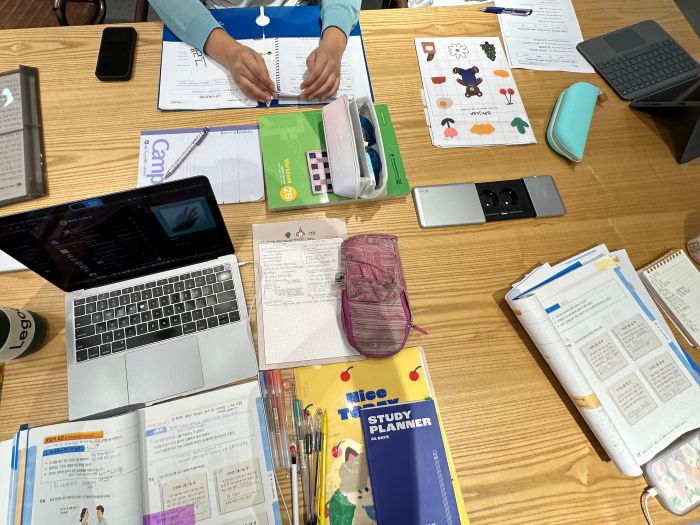
Cover Photo: A late-night group study session. (Courtesy of the author)