



More Than Football: The Friendships at the Mexico, US, Canada 2026 World Cup
By Luis Andrés ||
Before the first whistle was blown, millions of people had already formed expectations.
Mexico would be deserts and cacti, with lots of insecurity. Americans would be distant and unwelcoming. Canadians would be polite. The 2026 FIFA World Cup, the first ever hosted by three countries, spent an entire month proving how incomplete those assumptions were.
I am not really a football fan or follower, but as a Mexican living in Korea, I naturally followed every match involving either country. Yet by the end of the tournament, I realized the best stories had little to do with goals or trophies. They were happening in the streets outside the stadiums, on subway rides, in public squares, and between complete strangers wearing different jerseys. This World Cup reminded us that football may be the excuse, but friendship is often the real event.
One of the biggest surprises for many visitors was simply discovering Mexico itself. For decades, international media has often reduced the country to clichés of deserts, cacti, and dusty villages. Yet thousands of supporters arrived in cities like Monterrey and found something entirely different: a modern metropolis framed by the dramatic peaks of the Sierra Madre Mountains. The view of Estadio Monterrey sitting beneath Cerro de la Silla quickly became one of the tournament’s most shared images, with visitors admitting that Mexico looked nothing like they had imagined.
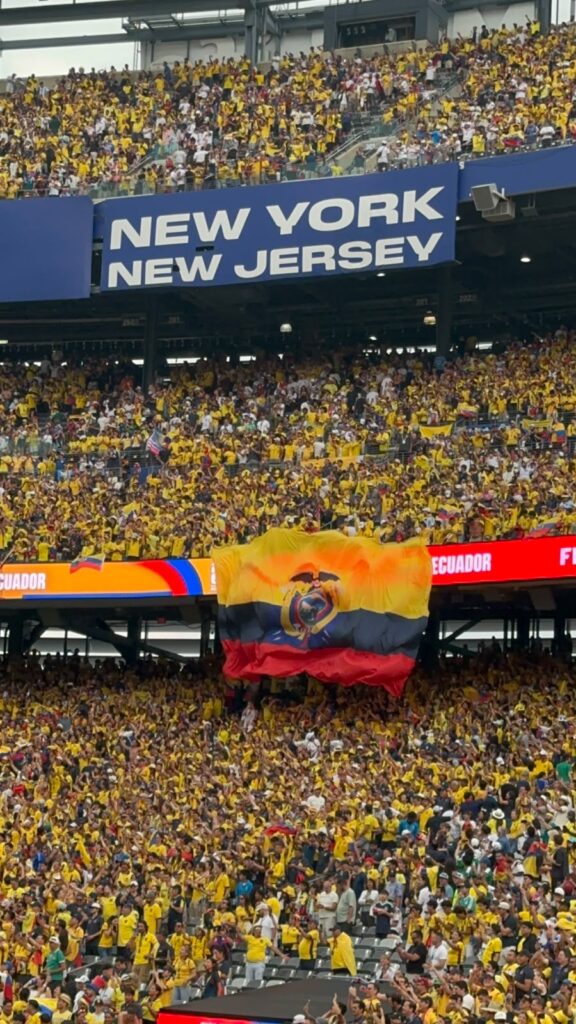
Ecuadorian fans unfurl a huge national flag to celebrate Ecuador’s victory over Germany at New York/New Jersey Stadium. (Alejandro Martínez)
The same happened with people. Every stadium became a meeting place for cultures that rarely cross paths. In Philadelphia, French and Iraqi supporters filled the same stands under enormous national flags before kickoff. In New York and New Jersey, Ecuadorian fans transformed the area around the stadium into what almost felt like a home match despite being thousands of kilometers from Quito. In Monterrey, Swedish and Tunisian supporters shared restaurants, public transportation, and photo opportunities with local families long before the referee blew the whistle. For a few weeks, national borders became little more than colors on a jersey.
Perhaps nowhere was this spirit more visible than in the relationship between Mexico and Korea. Korea played all three of its group-stage matches in Mexico. Although the results on the pitch were mixed, the atmosphere outside the stadiums could hardly have been warmer.
The Korean national team repeatedly thanked Mexico on social media for its hospitality. Korean supporters returned home with stories that had little to do with football tactics and everything to do with the people they met.
Videos spread across Korean social media showing fans dancing with Mexicans in city squares, joining spontaneous drinking games, celebrating together after matches, and embracing complete strangers. One particularly viral clip even showed Korean visitors participating in Mexico’s infamous three-person kiss – a tradition that certainly doesn’t represent Mexican culture but has somehow become an unofficial sign that foreigners have fully surrendered to Mexican party culture.
Seeing Korean fans laugh, dance, and celebrate with such openness surprised many people back home. Maybe they had simply met the right Mexican friends. Football rivalries, after all, have an expiration date.
Mexico happened to be the team that complicated Korea’s path to the knockout stage. For ninety minutes, they were opponents. Only for ninety minutes. The friendship returned almost immediately.
One small moment during the match captured this perfectly. Mexican head coach Javier Aguirre was seen joking in Spanish with Lee Kang-in, whom he had coached years earlier at RCD Mallorca. Despite standing on opposite sides that day, both smiled. Their shared history mattered more than the scoreboard. Football has a funny way of reminding us that today’s rivals are often yesterday’s teammates.
Mexicans have another way of expressing that idea. Whenever Korea has helped Mexico in previous World Cups – or whenever supporters from both countries meet in memorable ways – Mexican fans often chant: “¡Coreano, hermano, ya eres mexicano!” (Korean brother, you’re now Mexican). Whether in stadiums or public squares, the chant has become one of football’s most affectionate traditions, expressing something that many Mexicans genuinely feel: Korea is a country they enjoy cheering for almost as much as for their own.
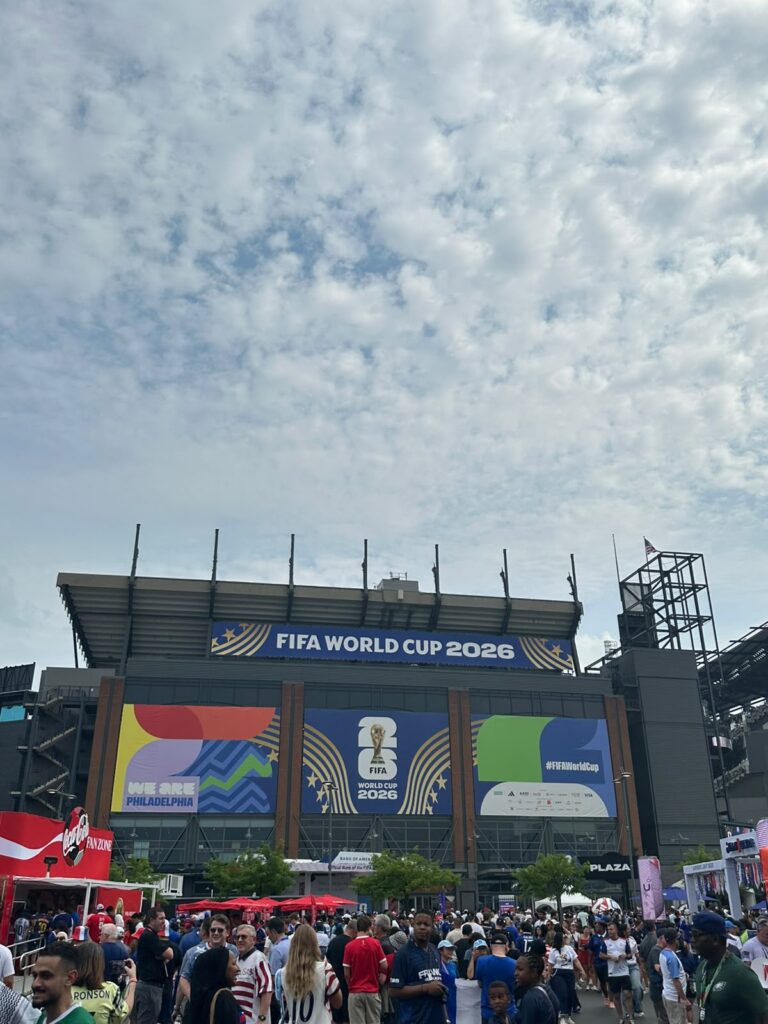
Philadelphia Stadium, minutes before the match between France and Iraq began. (Alejandro Martínez)
The phrase carries an even deeper meaning when viewed alongside the long history connecting the two nations. More than a century has passed since the first Korean migrants arrived in Mexico, helping build communities while becoming part of Mexican society. Few scholars dedicated more effort to documenting that shared history than the late Professor Kim Jae-gi of Chonnam National University, whose work helped many of us better understand the ties between our two countries. (It is to his memory that I dedicate this article.)
Perhaps that is the greatest achievement of any World Cup. Not the champion. Not the Golden Boot. Not even the unforgettable goals. It is giving countries that would otherwise rarely meet the opportunity to discover one another beyond headlines and stereotypes.
Mexico and Korea are far from perfect. Mexico continues chasing the elusive dream of making a deep run at a World Cup while facing the same political and social challenges that never disappear simply because football begins. Korea, meanwhile, leaves this tournament with difficult conversations about coaching, management, and the relationship between players, supporters, and the media.
But for one remarkable month, none of those differences prevented people from laughing together.
I often think of Mexico and Korea as two friends with opposite personalities. Mexico is the loud one – the one who insists everyone should dance. Korea is the quieter one – the one who says no. Then, twenty minutes later, everyone is singing together. Maybe that is what the World Cup is really for.
The Author
Luis Andrés González is a Mexican GKS scholar and master’s student in cultural anthropology at Chonnam National University. He advocates for LGBTQ+ rights and gender equality, and explores global affairs through pop culture. He is the founder of Erreizando, a digital magazine. Instagram: @luisin97 / @erreizando
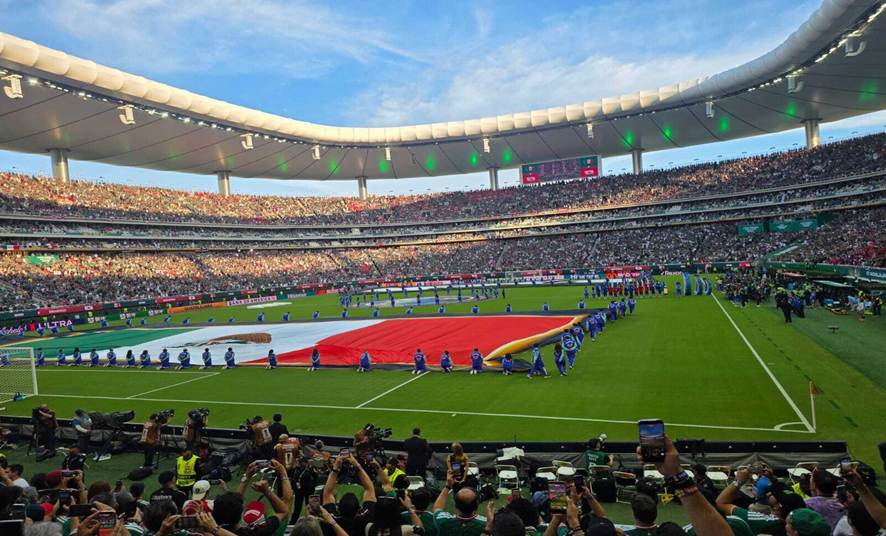
Cover Photo: Mexico’s flag awaiting the unfurling of the Taegeukgi for the national anthem ceremony. (Alejandro Mendez)