



Korea’s 100-Day Celebration: The Baegil
By Diane Dooley ||
Introduction
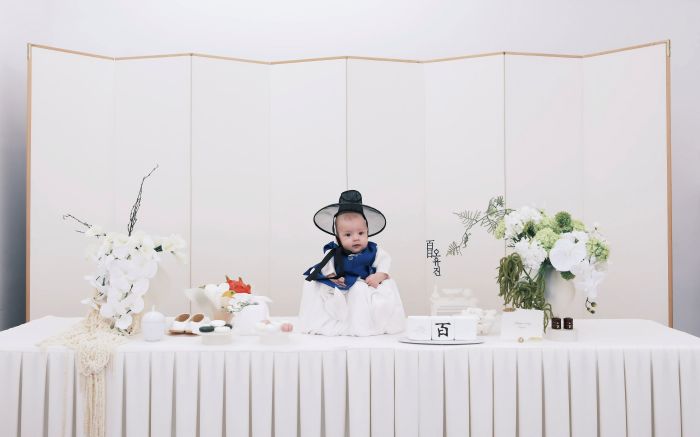
We carefully arrange the table decorated with rice cakes, fruit, and delicate flowers. We take a step back. Our three-month-old son, dressed in a hanbok, is sitting at the center of the table, looking straight at us. We are trying to get his attention. His head droops to one side suddenly, betraying his not-quite-there-yet neck strength, but he smiles. The photographer hits the shutter quickly.
While the rice cakes, fruit, and flowers on the table are fake, the significance of this occasion for us as parents is not. It is our son’s baegil (백일), the one-hundredth day since his birth, but we are celebrating more than just the passage of time.
In many countries, a child’s first birthday is regarded as his or her first big milestone. In Korea, however, the one-hundredth-day celebration has traditionally held equal importance.
This celebration emerged during a time when the birth of a child was fraught with uncertainty. For much of history, all over the world, infant mortality rates were extremely high until the early to mid-twentieth century, when developments in modern medicine, food production, and hygiene practices, improved outcomes significantly.
In this context, after one-hundred days, a newborn was considered to have survived the most vulnerable stage of infancy and was therefore more likely to see his or her first birthday (and, ultimately, adulthood). Anxiety transformed into hope, and people were finally able to celebrate.
However, the baegil is more than an acknowledgement of survival. It reflects centuries of cultural development on the Korean peninsula, shaped by mythology, indigenous beliefs, Buddhism, and Neo-Confucian philosophy. Its customs, from sharing white rice cakes with neighbors to displaying symbolic foods on a ceremonial table, express broader ideas about family, community, and life and death.
Although the social conditions that gave rise to the tradition have changed dramatically over the years, the baegil continues to be celebrated by families across Korea and throughout the Korean diaspora, connecting modern parents with generations of ancestors who observed the same celebration before them.
The Historical Origins of the Baegil
The precise origins of the baegil are unknown, and there are no surviving historical records that identify when the tradition began. This is because it was a folk tradition that developed gradually over time. In summary, the tradition emerged in response to the realities of life before modern medicine and was further influenced by indigenous beliefs, religions, and philosophies.
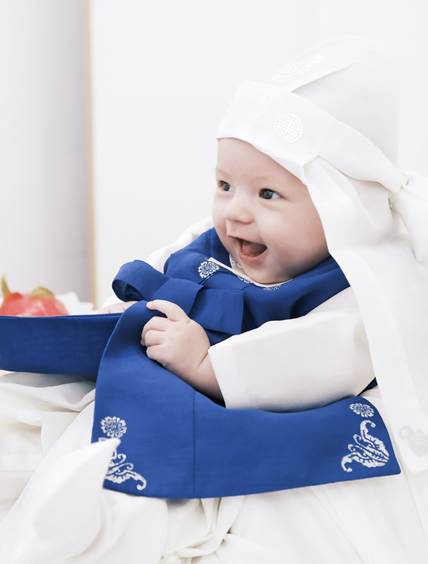
Boy in traditional bachelor’s hanbok.
In Korea, infant mortality rates were extremely high until the mid-twentieth century. In the early 1900s, the infant mortality rate was thought to have been somewhere around 500 per 1000 births. This figure did not drop below 100 until 1965. Life expectancy at birth during the Joseon Dynasty (1392–1910) was around 30 to 35 years. This low average is solely attributed to extremely high infant mortality rates. Infectious diseases such as smallpox, measles, dysentery, and respiratory illnesses such as tuberculosis, were common, and poor sanitation and hygiene, periodic famine, and limited access to medical treatment further exacerbated the issue.
As a result, families often approached the first months of a baby’s life cautiously. Surviving infancy was far from a given. In these circumstances, it is easy to see why a baby’s one-hundredth day was a cause for celebration.
“This celebration emerged during a time when the birth of a child was fraught with uncertainty.”
The Dangun Myth and the Symbolism of 100 Days
But why one hundred days? Although modern medicine has developed significantly, infants are still seen as extremely vulnerable for the first three months of life. This is the case not just in Korea but all over the world. Newborns have immature immune systems, are more vulnerable to infections, and undergo rapid growth during this period. Three months is just shy of one hundred days. Therefore, this is naturally an appropriate time for such a celebration.
In addition, the number one hundred also appears prominently in Korea’s founding myth as it is recorded in the Samguk Yusa (Memorabilia of the Three Kingdoms). In the legend, a tiger and a bear both wished to become human. Hwanung, a divine figure in the myth, told them to remain in a cave for one-hundred days, and to eat only mugwort and garlic. If they were successful, he would grant their wish and transform them into humans. The tiger left the cave before the one-hundred days was done, too hungry and impatient, while the bear was transformed into a woman after only twenty-one days. In this example, the one-hundred-day period symbolizes patience, endurance, and transformation. There is little evidence that the baegil celebration was directly influenced by the Dangun myth, but both point to a broader cultural understanding of one-hundred days as a meaningful period of perseverance leading to some sort of reward or transition, reinforcing the symbolic significance of one-hundred days as an important milestone in Korean culture and society.
Religious and Philosophical Influences
Although the celebration likely started due to the fear and subsequent gratitude and hope created by the high infant mortality rates, it was also influenced by contemporary belief systems and social norms. Rather than being the product of a singular belief system, the celebration reflects the pluralism of folk beliefs, Buddhism, and Neo-Confucianism. Together, these traditions influenced how Korean families understood things like childbirth, familial relationships, and the hopes they held for a child’s future.
Many of Korea’s folk beliefs focus on well-being and protection. For example, many viewed the period immediately after birth as one of vulnerability. This prompted the emergence of protective customs such as limiting visitors, hanging a geumjul (sacred straw rope) outside the home. The straw rope was intended to prevent the entrance of uninvited visitors as they could carry with them diseases or evil spirits could follow them inside.
Similarly, as Buddhism spread across the peninsula, families also sought blessings for healthy pregnancies and long lives for their children through prayers and acts of generosity, often making offerings at temples. During the Joseon Dynasty, Neo-Confucianism further shaped the baegil by emphasizing filial piety, family continuity, prudence, and the importance of life stages. Together, these traditions transformed the baegil from a celebration of survival into a meaningful expression of gratitude, communal support, and a display of hope for a healthy and prosperous life for the child.
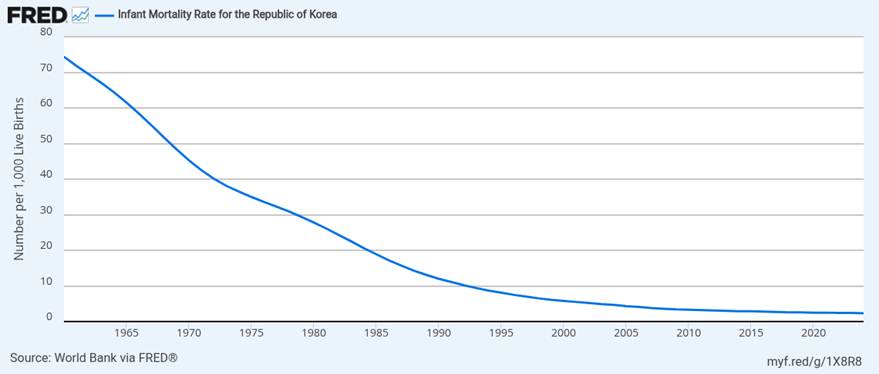
Infant mortality rate in South Korea since 1960.
The Baegil Table
How is the baegil actually celebrated? At the heart of the celebration is the baegil table (baegil-sang, 백일상). Traditionally arranged by family members, today the baegil-sang is more often arranged by professional photographers or event planners. The table usually features a selection of symbolic food and other items that represent the family’s wishes for the child’s health and happiness. While the composition of the table varies among families, regions, and photography studios, the purpose of it remains the same: to give thanks for the baby’s healthy growth so far and to express wishes for the baby’s future.
Special festive foods prepared for the table include a variety of rice cakes, such as baekseolgi, susupat-tteok, injeolmi, and songpyeon. Baekseolgi (steamed white rice cake) is symbolic because the first syllable, baek, can mean both “white” (白) and “one hundred” (百) Together, it symbolizes the wish for the child to live for one-hundred years. Its white color represents purity.
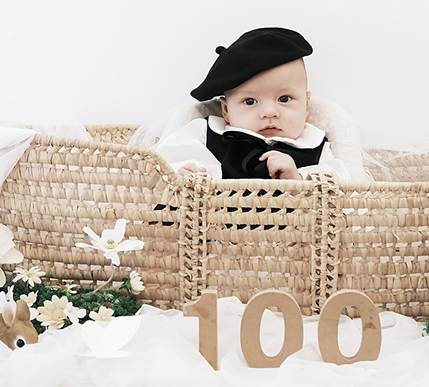
Photo studios usually provide a variety of different backdrops and outfits.
Susupat-tteok (rice cakes coated with red bean paste) was believed to repel evil spirits thanks to its reddish color, and injeolmi (rice cakes coated in roasted soybean powder) represents sincerity. Two kinds of songpyeon (half-moon shaped rice cakes) are made, one with fillings and the other without, representing strength and generosity.
Traditionally, the rice cakes were usually handed out not only to relatives and neighbors, but also to others who had not been formally invited to the event. It was believed that this would help the baby live a long life. The goal was to hand out rice cakes to one-hundred people, but it was not important to actually achieve this. The gesture itself was enough.
Some other elements of the traditional celebration are no longer regularly practiced. For example, a baby’s hair was often cut for the first time on his or her one-hundredth day. Similarly, a special hanbok with long ties was worn by the baby, representing the wishes of the parents for the baby to live a long life. This hanbok was usually a patchwork made from one hundred pieces of cloth. Today, hanbok are usually rented for the occasion.
The baekil-sang is still the main feature of the celebration today.
The Baegil in Contemporary Korea
Today, the one-hundredth day celebration remains an important milestone that celebrates the child’s first one-hundred days. While low infant mortality rates have seen the celebration take a backseat to the child’s first birthday celebration, most families still celebrate their baby’s baegil. Many families now choose to take a few commemorative photos either at home or in a professional photography studio before sharing a simple meal and rice cakes with family. However, the baegil table and the significance and symbolism of its components has remained consistent. It all comes together in a carefully curated expression of gratitude for the baby’s safe arrival and good health, appreciation for the support of family and friends and wider community, and hopes for the child’s future.
Sources
- Kendall, L. (1985). Shamans, housewives, and other restless spirits. University of Hawaii Press.
- Kim, S. (2017). The history of medicine use in the Joseon era. Korean Journal of Medical History, 26(2), 147–180.
- Kwon, T. H., & Shin, E. H. (1977). Demographic transition in Korea. Seoul National University Press.
- National Folk Museum of Korea. (2017a). Baegil. Encyclopedia of Korean Rites of Passage.
- National Folk Museum of Korea. (2017b). Geumjul. Encyclopedia of Korean Rites of Passage.
The Author
Diane Dooley is originally from Glasgow, Scotland. She has a BA in Korean and an MA in Korean literature from SOAS. She currently works in Gwangju as an English teacher.
Photographs courtesy of the author.
Cover Photo: Typical baegil-sang.