
The Birth of Jeonnam-Gwangju Special Metropolitan City: A Reunion After 40 Years, Its Meaning, and Its Challenges
By Shin Gyonggu ||
July 1, 2026: A New City of 3.2 Million Is Born
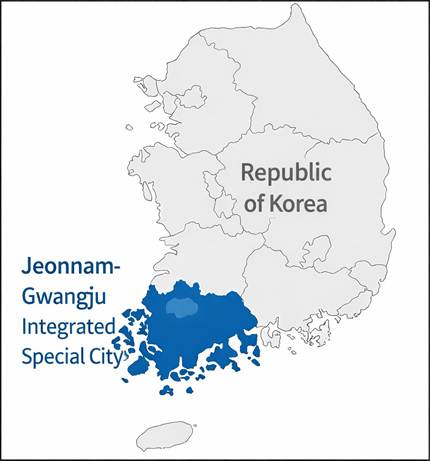
On July 1, 2026, the map of southwestern Korea was redrawn. Gwangju Metropolitan City and Jeollanam-do (aka South Jeolla Province; aka Jeonnam) weremergedintoasingleadministrative body – “Jeonnam-Gwangju Special Metropolitan City” (short form: Gwangju Special City). It is a reunion occurring exactly forty years after Gwangju was separated from South Jeolla in 1986 and elevated into a “metropolitan city” in its own right.
The new “special metropolitan city” has a population of about 3.2 million and a gross regional domestic product (GRDP) of roughly 159 trillion won. This places it fifth in the country by population and third – after Seoul and Gyeonggi – by economic size. Its legal status is equivalent to that of the Seoul Metropolitan Government. The special city mayor holds ministerial rank, its four vice-mayors hold vice-ministerial rank, and the mayor is entitled to attend national cabinet meetings.
For half a century, the Republic of Korea has been trapped in a “unipolar” structure that has concentrated population, capital, and opportunity in the Seoul metropolitan area, while pushing much of the rest of the country toward regional extinction. The Lee Jae-myung administration has vowed to break this pattern by reorganizing the national territory into five ultra-wide megacity “poles” and three “special autonomous provinces” – the so-called “5 Poles and 3 Special Zones” policy. The Jeonnam-Gwangju Special Metropolitan City is the first – and so far, the only – success story of this policy.
Why Merge? The “5 Poles and 3 Special Zones” and the Push Beyond Seoul
On February 2, 2026, the Democratic Party submitted a special bill to the National Assembly to establish the special metropolitan city. Similar bills for a Chungnam–Daejeon merger and a Gyeongbuk–Daegu merger soon followed. Yet only Jeonnam and Gwangju actually crossed the finish line. Chungnam–Daejeon, though it moved first, stalled amid local disagreement and partisan conflict, and the Gyeongbuk–Daegu bill was shelved altogether. What set Jeonnam and Gwangju apart from the others was a combination of factors: a shared historical identity going back beyond the 1986 separation, the political will of Gwangju Mayor Kang Ki-jung and South Jeolla Governor Kim Yeong-rok, and the strong personal backing from President Lee Jae-myung.
The urgency for the merger came from the severity of the regional crisis. Gwangju’s population peaked at 1.48 million in 2015 and has declined every year since, falling below 1.4 million in 2025. The steepest decline has been among the young: those aged 19 to 39 dropped from about 410,000 in 2020 to about 370,000 in 2024, a loss of more than 40,000 in only four years. South Jeolla’s condition is worse still. As of 2025, its population stood at about 1.78 million, shrinking by roughly 10,000 people a year in recent years. Twenty-nine percent of the population is 65 or older, while young children make up less than three percent.
In a situation where neither the city of Gwangju nor the surrounding province of South Jeolla could survive on its own, the essential logic of the merger was to reverse the trend through economies of scale with the strong support of the central government.
What the Merger Brings
Twenty-Trillion Won over Five Years: Extraordinary Central Government Support
Under the principle of “extraordinary support for those who move first,” the central government has committed roughly 20 trillion won (US$13.4 billion) in financial support to the new special metropolitan city, along with a substantial transfer of licensing and permitting authority. The city is now allowed to issue local bonds beyond the standard ceiling, and permitting procedures for development projects have been sharply streamlined. Sectoral incentives – for AI and energy industries, and for the transformation of the petrochemical and steel industries – are also written directly into the special act.
The 800-Trillion-Semiconductor Cluster: The Largest Investment in Korean Semiconductor History
The most dramatic change is in semiconductors. Samsung Electronics and SK Hynix will each invest 400 trillion won – 800 trillion won (US$535 billion) in total – to build four memory-chip fabrication plants in this region. It is the largest single investment ever committed to the Korean semiconductor industry. The site chosen is the former military airbase in Gwangju: 8.2 million square meters, or about 2.5 million pyeong.
The central government will phase in a power supply of 6.3 gigawatts and 650,000 tons of industrial water per day. The site sits next to the KTX Gwangju-Songjeong Station, making it easy to draw skilled workers. Lee Jae-myung’s “corporate-friendly advanced city” policy has, in effect, taken root in Gwangju.
Relocation of the Military Airbase – and Relief from Decades of Noise
Because the 800-trillion-won semiconductor cluster will occupy the current military airbase site, the fighter-jet noise that has plagued residents of Gwangsan-gu for decades will finally be resolved at its source. The airbase will be moved to Muan County, with relocation support funds and local development incentives provided to Muan in return. Because the site is already level, construction of the new fabrication plants will be able to begin unusually quickly.
The Consolidation of Gwangju Airport with Muan into an International Airport
The civilian aviation function of Gwangju Airport will be moved to Muan International Airport by the end of 2027, timed to the opening of Phase 2 of the Honam High-Speed Rail (KTX). Muan International Airport has, until now, operated no domestic flights at all and has struggled to grow. Once Gwangju’s civilian operations move there and KTX service reaches the airport directly, Muan will be reborn as a full-fledged international gateway for southwestern Korea. Renaming it “Kim Daejung Airport” is under active consideration.
A Chance to Resolve Gwangju’s Chronic Fiscal Deficits
Gwangju has long been under financial pressure from two sources: chronic operating losses of 70 billion won, or US$50 million, annually on Subway Line 1 and Line 2, targeted for completion in 2030. As the newly formed special metropolitan city now enjoys financial privileges on par with Seoul and receives concentrated support from the central government, there is finally a realistic basis for resolving this long-running structural deficit.
Reversing Population Decline and Attracting Talent
Whether this merger can reverse the region’s demographic decline is one of the most closely watched questions. President Lee Jae-myung has been unusually direct concerning the historical injustice underlying that decline. “In 1945, the population of the Honam region was larger than that of Yeongnam,” he noted, “but as a result of regional discrimination, Honam today has less than half the population of Yeongnam.” He publicly promised targeted support for Gwangju Special City and declared that “when the central government relocates its agencies to the regions, they should be concentrated in Gwangju Special City if we want any real effect.”
“Jeonnam-Gwangju Special Metropolitan City is a testing ground for balanced development in Korea.”
Min Hyung-bae, the first mayor of the newly formed special city, has framed the ambition this way: “The quality jobs that will emerge from semiconductor facilities, AI computing centers, and the offshore-wind and space-industry belts will be the stage on which our young people can pursue their dreams. We will make Jeonnam-Gwangju a destination that even young people in the Seoul metropolitan area move to.” Gwangju City’s decision to invest 1.5 trillion won in its 2026 population policy points in the same direction. Vice Mayor for Administration Ko Kwang-wan also depicts the shift in a phrase: “Jeonnam-Gwangju Special City will be favored by more young people and businesses over Seoul.”
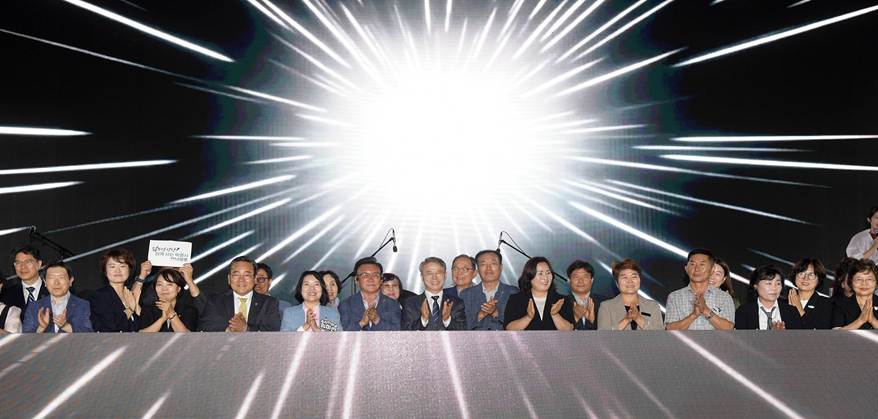
The July 1 launch festivities. (Jeonnam-Gwangju Special City)
Balanced Regional Development: An Old Dream
Underlying all of the above is one enduring aspiration: balanced regional development. To disperse the opportunities that have been concentrated in Seoul and the capital region, and to fill the southern land once again with the voices of its people. A column by Professor Jang Ha-sok of the University of Cambridge captures, with unusual grace, the long grief of a region that has been this country’s granary and moral home yet has also been consistently discriminated against:
“For a thousand years, Honam has been this nation’s granary, yet it has never been the master of its own granary. It holds the most fertile fields but has remained the periphery the longest; it has given the most, yet been given back the least. Its fertile land became the very reason for its exploitation, and its generous spirit became the pretext for its marginalization – this paradox is the history that this land has endured. In the age of industrialization, factories bypassed it, highways bypassed it, and eventually even human footsteps turned away. Its young people, unable to find a future in their own land, had to leave, and in the places they left behind only the sunset, empty houses, and old promises remained. People speak of this land in terms of han – a deep, historic sorrow – but I would rather call it a promise long deferred. A promise that someone must come to repay, yet that for a thousand years no one has repaid.”
As Professor Jang’s voice reminds us, this newly formed special city is not about the interests of one region. It is a first step toward the balanced development of the nation as a whole, and toward setting straight a crooked past.
The Shadowed Side: There Are Losses, Too
Behind every bright picture, there are shadows. Gwangju citizens must face the following concerns with honesty.
The Administrative Unit of “Gwangju” No Longer Exists
Under the special act, both Gwangju Metropolitan City and South Jeolla Province have been dissolved. Gwangju is now scattered across five autonomous districts – Dong-gu, Seo-gu, Nam-gu, Buk-gu, and Gwangsan-gu – and no single city hall now represents them as a whole. Mayor Min Hyung-bae has proposed creating a “Gwangju Administrative Office” to fill the resulting gap in metropolitan governance, but district mayors and district-council members are pushing back, calling it an inefficient extra layer, a “roof on top of a roof.”
Fear of a “Straw Effect” on Cities and Counties
The rural cities and counties of South Jeolla worry about a “straw effect” – the fear that their populations will be sucked into Gwangju, with its richer options for housing, education, and culture. The psychological and administrative distance built up over forty years of separation between South Jeolla and Gwangju will not vanish overnight.
The Identity of Gwangju as a Human Rights City Is Shaken
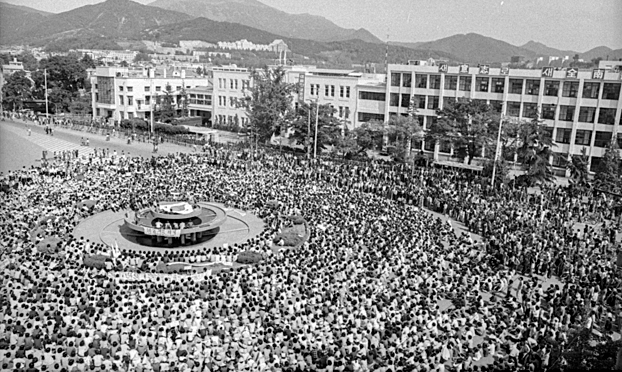
The most painful and weighty issue is identity. Since the May 18 Democratic Uprising of 1980, Gwangju has been known to the world as Korea’s symbol of democracy and human rights. Since 2011, the World Human Rights Cities Forum (WHRCF) has been held in Gwangju every year, and since 2020, the UN Office of the High Commissioner for Human Rights and UNESCO have co-hosted the Forum together with the City of Gwangju. In these settings, the name “Gwangju” has become a global brand for the human rights city. “Gwangju Metropolitan City” was never merely a political or administrative label; it was a shared label for human rights, used across international civil society.
“Whether this merger can reverse the region’s demographic decline is one of the most closely watched questions.”
That name “Gwangju Metropolitan City” has now been legally erased. How will we manage a situation in which the international human rights brand once carried by “Gwangju Metropolitan City” is replaced by “Jeonnam-Gwangju Special Metropolitan City”? Protecting the international assets Gwangju has accumulated as the city of May 18, as a human rights city, and as a city of democracy – so that these are not blurred by a change in administrative name – is a task the civil sector and Gwangju’s international partners must now shoulder together.
The Condition for Success: Direction, Not Size
Jeonnam-Gwangju Special Metropolitan City is a testing ground for balanced development in Korea. The outward conditions are in place: 20 trillion won (US$13.3 billion) in support, 800 trillion won (US$535 billion) in semiconductor investment, legal status on par with Seoul. But the real test now begins. Can the newly formed special city fully exercise substantive self-government authority over regional transportation, energy, wide-area infrastructure, large-scale investment attraction, and industrial transition? Can 3.2 million residents genuinely share, as a single community, the benefits it generates? And can the identity Gwangju has accumulated – as a home of democracy and human rights – be preserved within a new administrative name?
In this new setting, the roles of the wider civil society that has connected this city to the world become more important than ever. The administrative map has been redrawn, but the names by which Gwangju is known to the world – Human Rights City, City of May 18, City of Democracy – must continue to live in the memory of its citizens and in international solidarity.
Forty years ago, Gwangju was separated from South Jeolla. Forty years later, Gwangju has reunited with South Jeolla. May this reunion become Korea’s first successful model of balanced regional development – and, at the same time, an opportunity to carry the spirit of Gwangju as a global human rights city onto an even wider stage.
The Author
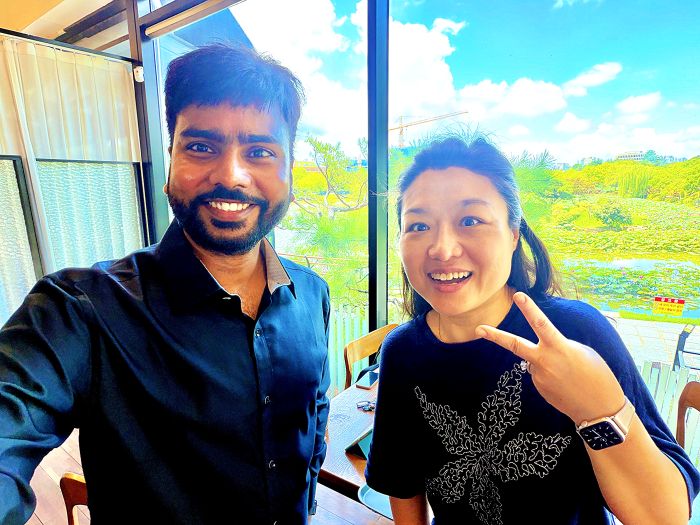
Shin Gyonggu has served the Gwangju International Center as its volunteer director for the past 27 years. He served as a professor for more than 30 years at Chonnam National University until his retirement in 2013. Dr. Shin is also the publisher of the Gwangju News.
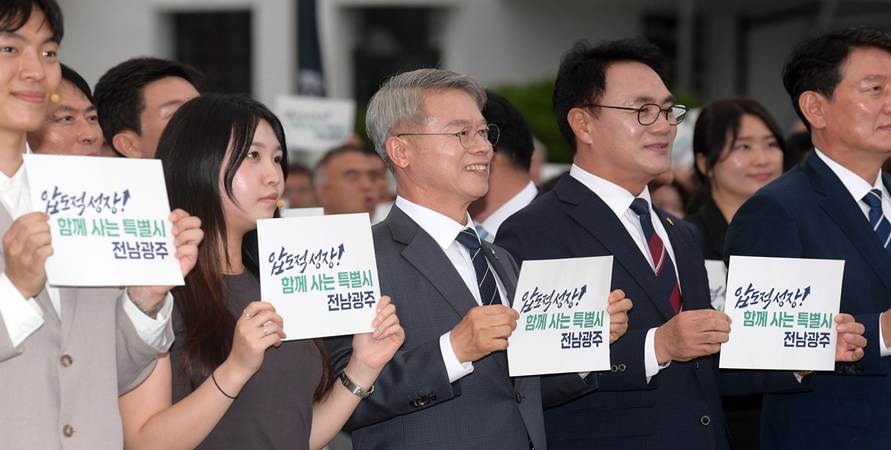
Cover Photo: “Overwhelming Growth! Living Together in the Special Metropolitan City – Jeonnam-Gwangju.” (Jeonnam-Gwangju Special City)