



The Environment: Chain of Thoughts – Solar Energy for the Home
By Chung Hyunhwa ||
I have been longing to use solar energy for my home, but it has not happened yet, except for little outdoor garden solar lamps. (They are extremely convenient because they do not need to be connected to a power outlet.) The easiest solution is to install solar panels connected to the grid, to KEPCO (the Korea Electric Power Corporation) here in Korea. There is financial support from the local government you could try applying for at the beginning of each year, but it takes some luck, since it is a popular program and has limited funds available.
What is good is that the cost of a home solar power system has fallen, so it is now about three million won for 3kW, which is about the same cost that you would have had to pay a few years ago even with a subsidy. A lot of people nowadays just make the switch to a home solar system without waiting for government support, avoiding the hassle of applying and wait for results.
My First Thought: A 3kW Solar Power System Connected to the Grid
Normally, your solar panels need to be connected to KEPCO. That way, you can send excessive electricity or receive electricity when you are short. The problem with this is that the connecting infrastructure is limited, and so the first thing to do is to check availability. I learned that the power grid needs to be in a perfect balance between the power supply and its consumption because blackout can occur not only when the power is in short supply but also when there is too much.
Solar generation sometimes needs to be curtailed or reduced due to excess sunlight on fine, clear days, especially when the consumption is low, such as on holidays when the industry slows down. It is a not-so-happy situation for the solar power plant owners. They want to earn money from their investment, but they can generate power only to the extent that it does not affect the entire grid system. Too often, curtailments can harm the solar inverters, so at this point, power generation is not the main issue, rather the efficient use of the power grid as a whole is.
My Second Thought: A Plug-in Micro Solar Power System?
I thought of how to avoid adding pressure to the power grid. From my research, I was happy to find that there are micro-solar-generation systems for homes that you can just plug in. Instead of 3kW, or 3000W, these are just 500W, 1000W, or 1200W; therefore, instead of installing five 600W panels, you could use only one or two panels, and instead of a 3kW inverter to change the electricity from DC to AC, you would need a 1000W or 1200W micro-inverter.
It seemed simple, since it is a plug-in. And it was going to be cheaper but still useful in reducing one’s electricity bill, since it is based on a graduated pricing system. However, it wasn’t that simple, because if 500W panels were installed, you would have to consume all of the generated energy at all times so that there would be no leftover electricity to enter the power grid. If it were to enter without being officially connected, it could cause problems. Home baseload can be very low, especially when no one is at home. There may be only a refrigerator, an internet modem, and some home appliances that are hooked up but not being used. Then, sometimes it is only about 100W being used, since even a refrigerator uses only a little energy when its compressor is not running.
When I discovered the details of the plug-in solar power system, my initial excitement quickly waned. Even a solar power system as small as this needed to be connected to KEPCO? It seemed that it was a lot of work for so little.
My Third Thought: An ESS System?
I thought more. If I got excessive solar energy, I could save it in an ESS battery, so it would not enter the power grid. I looked for a battery that matched a 1000W panel system. 1000Wh batteries were expensive, if I wanted a KC-certified product. Maybe too expensive, compared to the 3kW solar power system connected to KEPCO. Also, my disappointment was that there were no KC-certified micro-solar inverters or batteries at decent prices. This is understandable, since the demand for them is not so high. I decided that I should not get an uncertified product, as it could be a fire hazard.
My Final Thought: Back to the 3kW System
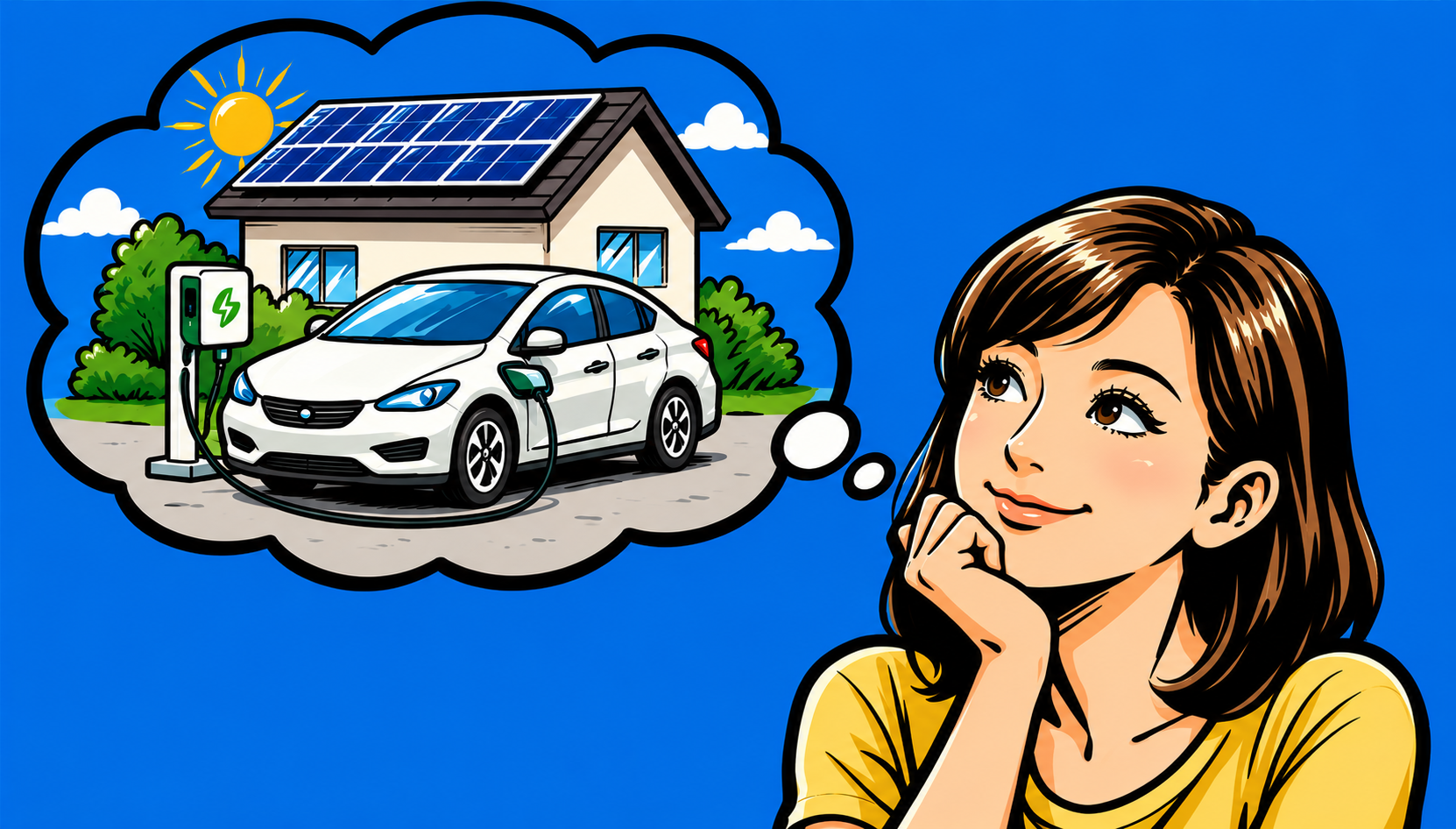
My whole point was to have an independent solar power system that does not threaten the power grid, and to use the energy I harvest during the day without throwing any away. However, safety also matters. Now, my thoughts go back to getting an electric vehicle to function as a battery system. I could charge it with the leftover energy harvested during the day. A hybrid inverter can make this possible. It would primarily allow the home appliances to use the energy from the panels, but if there is leftover energy, it would charge the electric car battery.
I use a car only a couple of days a week, so if the weather is good, I could use the car after two days of charging without any problem. (Of course, this wouldn’t work for people who use their car daily.) When home generation is not enough, I could use a public fast charger to charge the car battery, which would take about 30 minutes. When I am not at home would be the only time my solar power system would send power to KEPCO. To minimize this, I could have the water heater boil water during the day using a timer switch, run the washing machine, turn on the air-conditioner or the heater, or save the energy in a small battery for emergencies.
Now, I have a plan. All I need now is to install a solar panel system, and to buy an electric car and a car charger! Now, which car should I buy?
Another chain of thoughts begins…
The Author
Chung Hyunhwa, a native of Gwangju, recently worked for a local horticultural company. She led the international eco-hike group Gwangju Hikers at the GIC in 2020 and 2021. Previously, she taught English at Yantai American School and Yantai Korean School in China and worked in school administration at Branksome Hall Asia in Jeju. She holds a master’s degree in TESOL from TCNJ in the U.S. and has a license to teach Korean. She loves plants, birds, dogs, and repurposing items creatively.
Cover Photo: Solar power system thoughts. (GN with Copilot & ChatGPT)