


The Heat Beneath Our Feet: Gwangju’s Summer Islands
By Siddhant K. ||
Step off the bus on Gwangju’s Geumnam-ro at 9 o’clock on a summer evening, and the day’s heat is still there, radiating up from the asphalt like the memory of an argument. Ten kilometers away on the lower slopes of Mt. Mudeung, the air has already softened into something breathable. Same city, same hour, a difference you can feel on your skin. That difference has a name: urban heat island.
What Is an Urban Heat Island?
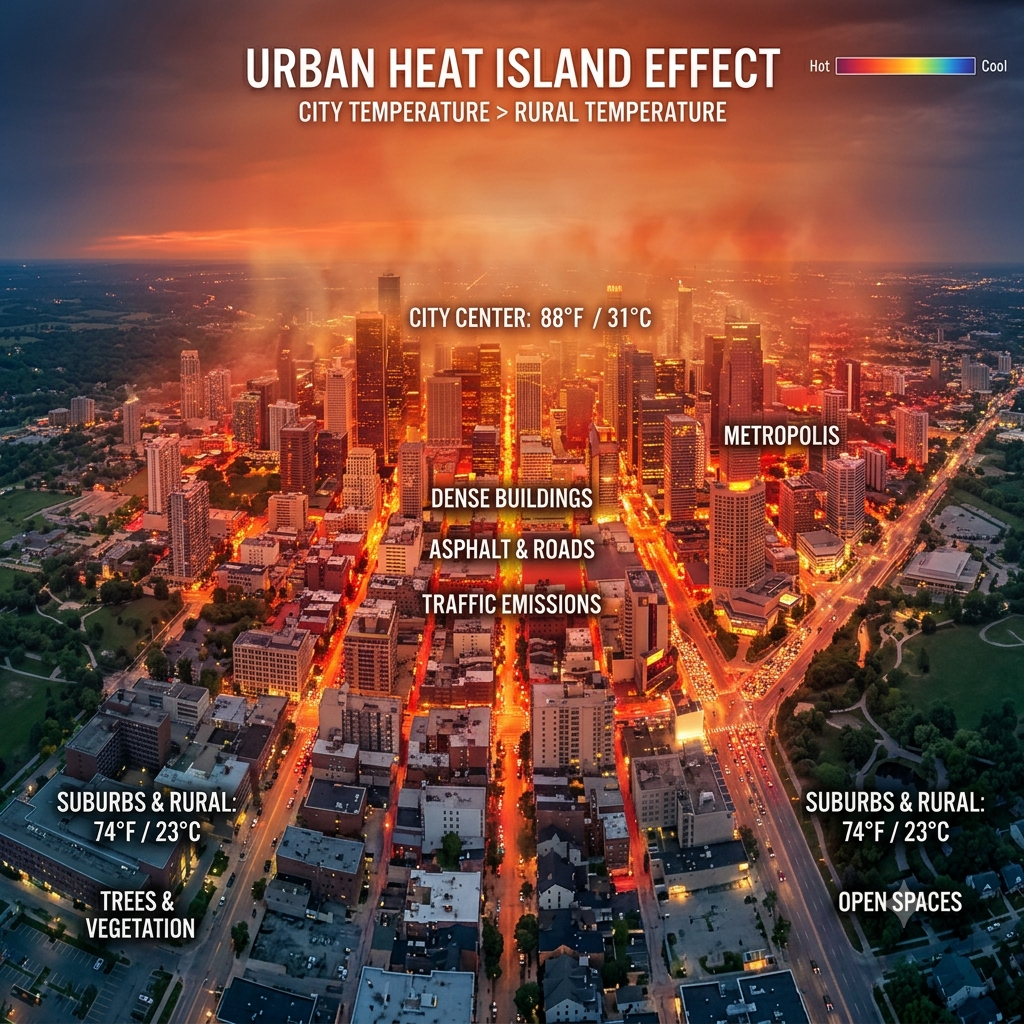
An urban heat island forms when a city becomes measurably warmer than the countryside around it. The mechanics are simple and stubborn. Concrete, asphalt, and dark rooftops absorb solar radiation all day and release it slowly through the night. Buildings block the wind that would otherwise carry heat away. Cars, air conditioners, and industry add their own waste heat to the mix. And because paved surfaces shed rainwater into drains rather than holding it in soil and vegetation, cities lose the natural air conditioning that comes from evaporation and plant transpiration.
The result is a city that cannot cool down. Daytime highs are only part of the story; the more dangerous signature of the heat island is the tropical night, when temperatures never drop below 25 degrees and the body gets no overnight recovery. For older residents, outdoor workers, and people in poorly insulated housing, that relentlessness is not a matter of comfort but of health. Korea’s heat waves have grown longer and more intense over the past decade, and dense urban districts feel every extra degree first.
Gwangju is not exempt. Our city’s geography, a broad basin opening toward the west, with Mt. Mudeung standing to the east, means summer air can sit and stew over the urban core. The contrast between the leafy edges of the city and the hard-surfaced downtown is exactly the temperature gap that heat-island researchers measure. The Korea Meteorological Administration has even developed a neighborhood-level heat comfort index for Gwangju, modeling temperature and wind at 300-meter resolution across the city’s administrative dongs, an acknowledgement that in summer, your address matters.
Planting a Cooler City
So, what is being done? The most visible answer is trees. This year, Gwangju is creating ten new urban forests with a budget of roughly 2.06 billion won, drawn from both national and city funds. The projects fall into two categories: fine-dust reduction forests, which double as heat-island mitigation, and green welfare forests, aimed at vulnerable communities.
The list of sites reads like a map of the city’s hottest corridors. Wind-path forests, plantings designed to channel cooler air from the mountains through the urban core, are planned along Pilmun-daero in Dong-gu, in Pungam-dong in Seo-gu, along Hyocheon 3-ro and at Yuan Neighborhood Park in Nam-gu, and in Suwan-dong in Gwangsan-gu. Three elementary schools (Bangnim-dong, Wolsan-dong, and Seonun-dong) will receive child-safe green forests, and Chonnam National University will host a new neighborhood forest. City officials describe urban forests as essential infrastructure: They absorb carbon dioxide, filter fine dust, lower perceived temperatures during heat waves, and provide residents with shaded places to simply sit.
“An urban heat island forms when a city becomes measurably warmer than the countryside around it.”
Science supports ambition. Mature street trees can dramatically lower surface temperatures beneath their canopies, and well-designed green corridors genuinely do move cooler air through a city. The honest caveat is time: A sapling planted this spring will not cast meaningful shade until the 2030s. Urban forestry is a promise to the next decade, not a fix for next month’s heat advisory.
The White Roof Experiment
Faster relief may come from above, specifically, from paint. “Cool roofs” are rooftops coated in highly reflective material, so they bounce solar radiation back instead of absorbing it. It is one of the cheapest heat interventions available, and Gwangju’s Nam-gu district has quietly become a local test bed.
Last year, Nam-gu invested around 330 million won to expand its cool-roof program, coating the roofs of six neighborhood administrative welfare centers, a health support center, a children’s center, and 34 homes of climate-vulnerable households in Songam-dong. What makes the program noteworthy is that the district followed up: A survey of low-income residents who received cool roofs in an earlier round found that most reported cooler indoor temperatures and reduced air-conditioner use afterwards. That is the right way to do climate adaptation: Target the people most at risk, then check whether it worked.
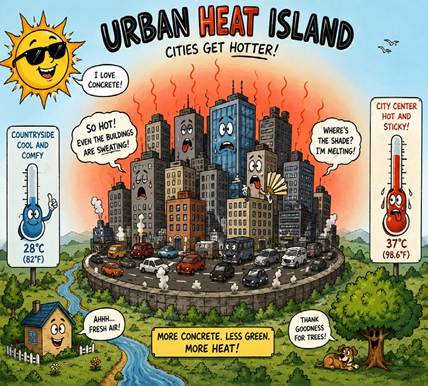
(GN with ChatGPT)
The city government has also folded cool roofs into its broader climate-crisis programming alongside its carbon-neutrality drive. Gwangju has set itself a 2045 carbon-neutrality target, five years ahead of the national goal, and recently ranked first nationwide in the government’s Carbon Neutrality Point System, which rewards residents for low-carbon choices. Meanwhile, the International Climate and Environment Center, founded by the city in 2012, continues to connect Gwangju to a global network of cities working on urban climate resilience.
Surviving the In-Between Years
Policies measured in decades still leave the question of this summer. Here, the city’s answer is shelter, literally. Hundreds of designated heat-wave shelters (무더위 쉼터), mostly in senior centers, community centers, and banks, operate from mid-May through the end of September. You can find the one nearest you through the National Disaster and Safety Portal (safekorea. go.kr) or the Safety Stepping Stone (안전디딤돌) app. This year, Gwangju is also running dozens of rest shelters specifically for mobile workers, delivery riders, designated drivers, and couriers, whose workplaces are the hot streets themselves.
For international residents, the practical checklist is short: Know where your nearest shelter is, take heat-wave alerts on your phone seriously, check on elderly neighbors during tropical-night stretches, and treat the hours between 2 and 5 p.m. with respect. If your building has a flat, dark roof, ask your landlord or building committee whether a district cool-roof subsidy applies; the programs expand yearly, and demand helps them grow.
Do the Policies Stack Up?
Measured against the scale of the problem, Gwangju’s response is real but modest. Ten urban forests and a few dozen white roofs will not dismantle a heat island built from decades of asphalt. What they represent is direction: A city that has stopped treating summer heat as weather and started treating it as infrastructure, something that can be designed, budgeted, and corrected.
The deeper test will come in planning decisions we rarely connect to temperature: how much green space survives each redevelopment, whether wind corridors are protected from high-rise walls, and whether adaptation money keeps flowing to the neighborhoods that need it most rather than the ones that photograph best. Heat islands are made one paved lot at a time. They will be unmade the same way.
The Author
Siddhant K. is a geochemical ocean-ographer and researcher at TMBL at the Gwangju Institute of Science and Technology (GIST). His work focuses on marine minerals, sediment chemistry, and paleoenvironmental change. He is passionate about communicating ocean science to broader communities in Korea.
Cover Photo: The urban heat island effect. (GN with Gemini)