




AI in Gwangju: The City’s Vision for Becoming an AI Hub
By Muhammad Umar Tahir ||
Gwangju is preparing to turn the entire city into one enormous artificial intelligence laboratory. Roads, hospitals, government offices, cultural spaces, universities, and even ordinary neighborhoods could become places where new technologies are tested and improved. The ambition is clear: AI should not remain hidden inside research centers. It should appear in safer streets, faster public services, stronger local companies, and better opportunities for residents.
For decades, Gwangju has been known as the city of democracy, human rights, and culture. It is now adding another identity to that historic reputation. Through major public investment, company attraction, talent development, and citywide testing programs, Gwangju is attempting to establish itself as one of South Korea’s leading AI cities – and eventually as an international center for cooperation in artificial intelligence.
The foundation was built during the first phase of the AI-Centered City initiative from 2019 to 2024. At the heart of the project is the National AI Data Center, which provides powerful computing resources to companies, universities, and research institutions. This allows startups and researchers to develop advanced technologies without purchasing extremely expensive equipment on their own.
The results have already begun to appear. Gwangju signed cooperation agreements with more than 350 companies, while over 160 businesses established headquarters or branch offices in the city. The growing ecosystem created 2,173 jobs, supported more than 2,000 research and development projects, and produced 687 patents. Fifteen regional companies have also received CES Innovation Awards, showing that Gwangju-based technologies are beginning to gain recognition beyond Korea.
Thousands of people have also completed AI education and professional training programs. These efforts are particularly important for a region that has struggled with the continued departure of young people seeking jobs in Seoul and other larger economic centers. By linking education with local companies and new industries, Gwangju hopes that more students will be able to study, work, and build their futures without leaving the region.
However, Gwangju is no longer satisfied with simply owning major facilities or signing agreements with companies. The city is now entering a more decisive stage: proving that its AI investment can create real businesses, stable employment, and services that citizens can experience directly.
Beginning in 2026, approximately 600 billion won is expected to be invested over five years in the AI Transformation (or AX) Demonstration Valley. The project will apply artificial intelligence to major regional industries such as mobility and energy while expanding support for startups, research, product testing, and commercialization. The long-term vision is to gather as many as 1,000 AI-related companies and create more than 6,000 jobs.
One of the most ambitious elements is the proposed “Regulation-Free AI Demonstration City.” Rather than limiting experiments to a single laboratory or short-term project, Gwangju intends to allow new AI services to be tested continuously across the city. Government agencies, universities, companies, and public institutions would work together to identify regulatory obstacles and move successful technologies more quickly toward commercial and public use.
The first areas of focus are closely connected to everyday life: traffic safety, medical care, public administration, the living environment, and cultural services. This could include systems that reduce traffic accidents, improve emergency responses, assist elderly residents, support people with disabilities, or make public services more convenient. Gwangju’s autonomous-driving and smart-mobility projects are also expected to become part of this larger demonstration environment.
In simple terms, Gwangju wants to make the city itself a testing ground. A company developing an AI traffic system could test it on real roads. A healthcare startup could work with hospitals and public institutions. Researchers could use local data to address actual community problems. Successful services could then move from the testing stage to wider public use without the long delays that often prevent new technology from reaching the market.
The startup sector will play a central role in this transformation. Gwangju was recently selected as one of South Korea’s four major technology startup cities, together with Daejeon, Daegu, and Ulsan. The city plans to create a unified support system connecting universities, research institutes, investors, and public organizations.
By 2030, Gwangju aims to discover and nurture 500 promising deep-tech startups. Gwangju Institute of Science and Technology is expected to become a major center for this effort through the planned establishment of a Startup Institute and stronger support for professors and researchers who wish to launch companies. The goal is to prevent valuable technologies from remaining inside university laboratories and instead help them grow into businesses capable of attracting investment and creating jobs.
Gwangju’s AI strategy is also expanding beyond the boundaries of the former metropolitan city. The launch of the Jeonnam–Gwangju Special Metropolitan City has created a much larger regional platform combining Gwangju’s AI, research, mobility, and cultural strengths with Jeonnam’s renewable energy, agriculture, maritime industries, semiconductors, and large-scale computing infrastructure.
This combination gives the region an unusually diverse testing environment. AI services can be developed not only for busy urban districts but also for farms, islands, coastal communities, industrial complexes, and areas facing population decline. Technologies developed here could address challenges shared by many other regions, including aging populations, healthcare shortages, climate change, energy transition, food security, and the widening gap between urban and rural communities.
The city’s ambitions are now reaching the international stage. A recent Gwangju Institute report proposed attracting a United Nations AI Hub to the region. The idea remains a policy proposal rather than a confirmed UN plan, but it reflects a significant change in direction. Gwangju no longer wants to compete only with other Korean cities. It wants to become a base for international AI cooperation, especially with developing countries.
Under the proposal, the hub could provide AI education, computing support, and data services for UN organizations. It could also operate demonstration projects in healthcare, education, climate, energy, food security, and labor while supporting developing countries through international aid programs. Gwangju could eventually become a meeting point where governments, companies, researchers, and international organizations discuss global AI rules and standards.
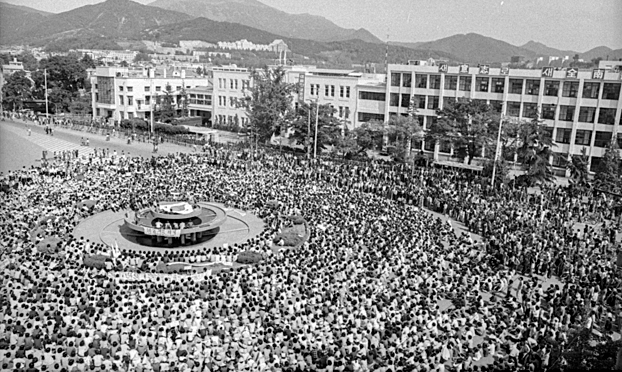
The city believes that its strongest advantage is not technology alone. Gwangju’s history as the home of the May 18 Democratization Movement gives it a powerful identity in discussions about human rights, democratic participation, and responsible government. As concerns grow worldwide over AI surveillance, discrimination, privacy, and cultural bias, Gwangju hopes to present a different model – one in which technology develops alongside public accountability.
The Asian Culture Center and the city’s wider cultural network could also support this international role. Many modern AI systems are built mainly around English-language and Western-centered information. Gwangju’s position as an Asian cultural city could help encourage technologies that better recognize different languages, cultures, and social experiences, particularly those of developing countries.
Despite the impressive plans, becoming a true global AI hub will not be easy. Gwangju must convert public investment into sustainable companies, attractive jobs, and services that residents actually use. It must persuade talented young people to remain in the region and convince companies not merely to open symbolic branch offices but to build lasting operations.
“Gwangju has already built the physical foundation of an AI city.”
The city must also ensure that rapid technological development does not weaken privacy, fairness, or citizen participation. AI should not become something imposed on residents without explanation. For Gwangju’s vision to succeed, citizens must be able to understand how these systems work, question their use, and share in their benefits.
Gwangju has already built the physical foundation of an AI city. The next chapter will determine whether that foundation can transform the regional economy and improve daily life. By combining technology with its traditions of democracy, human rights, and cultural inclusion, Gwangju is attempting something more ambitious than becoming another high-tech city. It is trying to show that the future of AI can be both advanced and deeply human.
Resources
Song B. (2026, July 4). Gwangju should leap forward as a hub for international cooperation by attracting the UN AI hub. The Asia Business Daily.
Gwangju City and MSIT launch nation’s first “Regulation-Free AI Demonstration City.” (2026, April 2). Smart City Korea.
Gwangju selected as AI technology-centered startup city. (2026, April 28). Invest Korea.
Gwangju AI ecosystem: Results produced, bigger leaps ahead. (2026, April). Invest Korea.
The Author
Muhammad Umar Tahir is an electrical engineer pursuing his PhD in the Artificial Intelligence Convergence Department at Gwangju Institute of Science and Technology (GIST). He is interested in applying AI to healthcare devices, particularly in advancing medical imaging technologies and brain stimulation.