




Your Job, Your Rights: A Migrant’s Guide to Protection in Korea
By Saqib Sharif ||
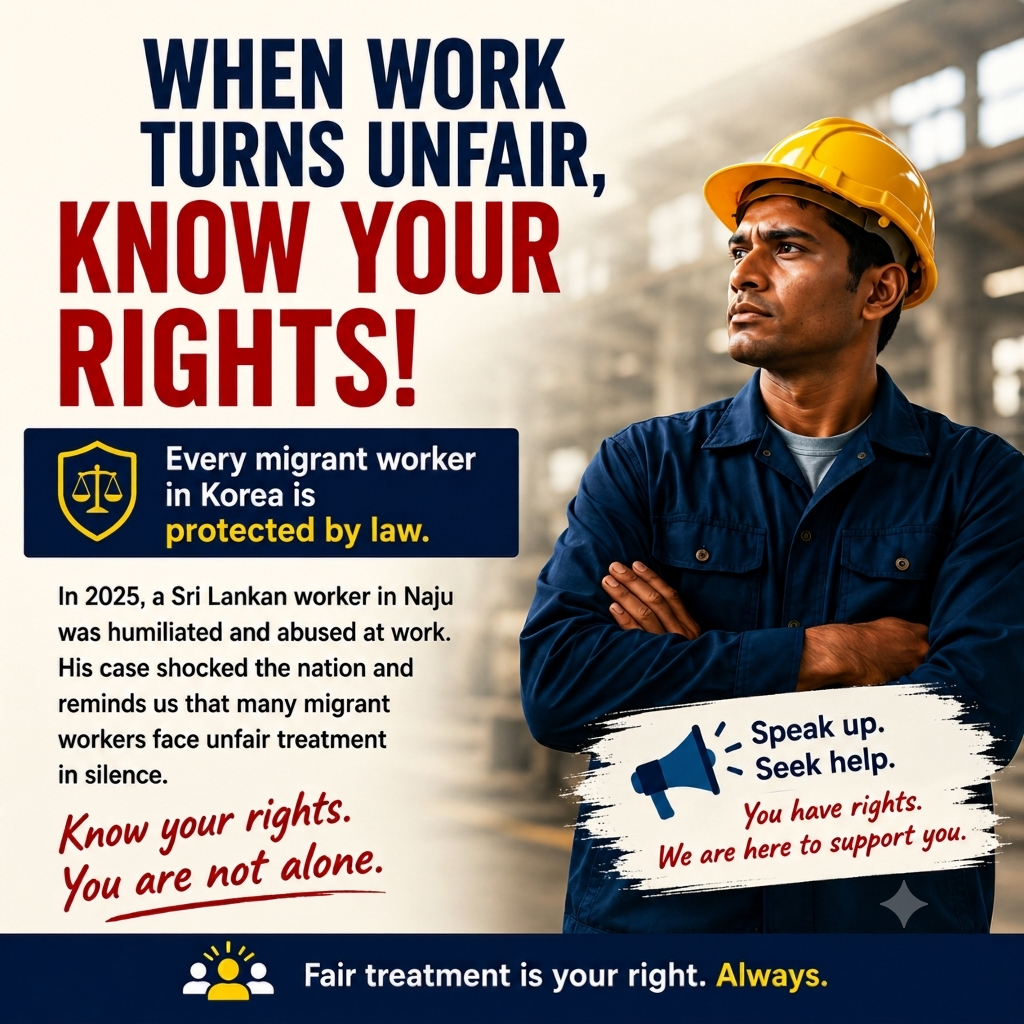
Last summer, a disturbing video from a brick factory in Naju, near Gwangju, shocked the nation. The footage showed a 31-year-old Sri Lankan worker tied to a stack of bricks with industrial plastic wrap and lifted into the air by a forklift while coworkers laughed and recorded the incident on their phones. According to labor rights organizations, the worker had already experienced repeated workplace bullying before finally seeking help. The incident quickly became national news, prompting investigations by labor authorities and public condemnation from political leaders. What many people saw as a shocking act of humiliation was, for migrant worker advocates, a reminder of a larger reality: Many foreign workers do not know where to turn when workplace problems begin, and many endure unfair treatment because they fear losing their jobs, their housing, or even their legal status in Korea.
“The most powerful protection available to any worker is knowledge.”
The Naju case highlights an important lesson for every foreign worker in Korea. Knowing your rights before a problem occurs can make the difference between remaining trapped in an abusive situation and obtaining the protection that Korean law provides. While most employers treat their foreign employees fairly and professionally, migrant workers sometimes encounter situations involving unpaid wages, workplace harassment, pressure to resign, unsafe working conditions, discrimination, or demands to perform work that bears little resemblance to the job they originally accepted.
One of the most common misunderstandings among foreign workers is the belief that they have fewer legal protection than Korean citizens. In reality, Korean labor laws generally apply equally to both Korean and foreign employees. Whether a worker comes from Pakistan, Sri Lanka, Vietnam, Nepal, the Philippines, Indonesia, or any other country, that worker is entitled to receive wages, work in a safe environment, and be treated fairly under Korean labor regulations.

A Sri Lankan worker is seen tied to a forklift at a brick factory in Naju, South Korea. (Gwangju Jeonnam Migrant Workers’ Human Rights Network)
Problems often begin subtly. A supervisor may repeatedly insult a worker, exclude them from workplace communication, or assign unreasonable workloads. Sometimes managers use a worker’s limited Korean language ability to pressure them into accepting decisions they do not fully understand. In other situations, workers are told they should simply tolerate unfair treatment because they are foreigners. Such behavior can create a climate of fear and isolation, particularly when employees are unfamiliar with the legal system or lack access to reliable information.

Among the most serious situations faced by migrant workers is pressure to resign. A manager may suggest that it would be easier for everyone if the employee submitted a resignation letter. The worker may be told that the company can no longer support them or that resigning voluntarily will avoid future complications. In some cases, employers intentionally encourage resignation because it is easier than formally terminating an employee. This distinction is extremely important. A resignation is not the same as a dismissal. When a worker voluntarily resigns, they may lose important legal protections and make it more difficult to challenge the separation later. By contrast, if an employer terminates a worker, Korean labor law generally requires legitimate reasons and proper procedures. For this reason, workers should never feel pressured to sign resignation documents immediately. Taking time to understand the situation and seeking professional advice can prevent significant legal problems in the future.

Another common source of conflict occurs when workers are asked to perform duties that were never part of their original employment agreement. An engineer may be assigned routine manual labor. A researcher may be ordered to perform unrelated administrative work. An office employee may suddenly be transferred to factory production. Although employers have some flexibility to assign duties within reasonable limits, substantial changes to a worker’s responsibilities can raise legal concerns, particularly when those changes affect visa conditions, professional qualifications, safety requirements, or compensation.
Employment contracts are not meaningless paperwork. They are legal documents that establish the expectations of both the employer and the employee. Foreign workers should always keep copies of employment contracts, offer letters, job descriptions, salary agreements, and important workplace communications. These documents often become critical evidence when disputes arise regarding working conditions or job responsibilities.
Wage-related disputes remain another major concern. Every year, foreign workers seek assistance for delayed salaries, unpaid overtime, unauthorized deductions, and disputes regarding severance pay. Korean law requires employers to pay workers properly and on time. Employees should maintain records of attendance, work schedules, salary deposits, and pay slips whenever possible. Even simple records can become valuable evidence if a worker later needs to file a complaint.
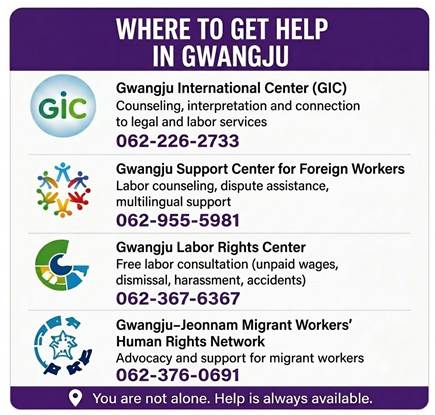
For some migrant workers, immigration concerns create an additional layer of vulnerability. Workers on certain employment visas may worry that leaving an abusive workplace could jeopardize their ability to remain in Korea. This fear often discourages workers from reporting violations. Labor advocates have repeatedly argued that concerns about employment status should never prevent workers from seeking help when their rights are being violated. The Naju case brought renewed attention to these concerns after the victim reportedly faced uncertainty about his future employment and residency status after leaving the workplace. Fortunately, migrant workers in the Gwangju and Jeonnam region have access to a growing network of organizations dedicated to protecting labor rights and supporting foreign residents. Listed here are a number of them.
The Gwangju International Center (GIC, 광주국제교류센터) has long served as a bridge between foreign residents and local services. Through counseling and community support, it helps foreign residents connect with legal, labor, and social welfare resources. Phone: 062-226-2733
The Gwangju International Residents Center (GIRC, 광주외국인주민지원센터) provides interpretation services, labor consultations, residency-related assistance, Korean language education, and support for foreign communities living in the region. The center was established with support from Gwangju City and the Ministry of Employment and Labor to assist foreign residents in settling successfully in Korea. Phone: 1644-3828
The Gwangju Support Center for Foreign Workers (광주외국인노동자지원센터) offers multilingual counseling, labor rights education, interpretation services, and assistance with wage disputes. The center has helped many workers recover unpaid wages and resolve workplace conflicts. It was established with support from the Ministry of Employment and Labor and specifically focuses on the needs of migrant workers. Phone: 062-946-1199
The Gwangju Labor Rights Center (광주노동권익센터) labor counseling and legal assistance for issues such as unfair dismissal, unpaid wages, workplace harassment, and industrial accidents. The center was launched by Gwangju City as a labor rights hub for all workers, including foreign workers. Phone: 062-951-1981 or 1588-0620
Workers may also contact the Ministry of Employment and Labor, the Korea Legal Aid Corporation, certified labor attorneys (노무사), and the 1345 Immigration Contact Center for specialized legal or immigration-related assistance.
The most powerful protection available to any worker is knowledge. Employers have legal obligations, and workers have legal rights. Understanding those rights does not create conflict. It creates fairness. Migrant workers contribute enormously to Korea’s economy, research institutions, factories, farms, universities, and communities. They deserve the same dignity, respect, and protection afforded to every other worker.
The Sri Lankan worker in Naju became a symbol of a much larger issue. His story reminds us that labor rights are not abstract legal concepts. They affect real people, real families, and real futures. Every migrant worker should know that unfair treatment is not something they must simply endure. Help is available, protections exist, and no one should face workplace abuse alone.
Web Sources
- Forklift Abuse Case in Naju (2025): Sri Lankan Migrant Worker Humiliated at Naju Brick Factory, Labor Authorities Launch Investigation. Chosun Biz, July 2025. https://biz.chosun.com/en/en-society/2025/07/24/HZQNHOCJF5EJ PPFLZU57QDFHRI/
- Migrant Worker Testimony and Follow-Up Investigation: Migrant Worker in Naju Speaks Out After Forklift Abuse. Korea JoongAng Daily, August 2025. https:// koreajoongangdaily.joins.com/news/2025-08-04/ englishStudy/bilingualNews/Migrant-worker-in-Naju-speaks-out-after-forklift-abuse-KOR/2367787
The Author
Saqib Sharif is a robotics engineer with a PhD in mechanical engineering, specializing in the design of smart healthcare devices and microrobots. With a strong background in medical technology and innovation, he is passionate about creating solutions that enhance smart healthcare. Dr. Sharif has been living in Gwangju for the past ten years. Currently, he serves as a senior researcher at Shinsung Tech Pvt. Ltd., Gwangju.