

From Agreement to Action: Samarkand and Gwangju Cooperating Since 2023
Expanding ties in economic development, culture, and education
By Kamila Ismanova ||
In the ever-changing economic and geopolitical landscape, forming diplomatic ties and interregional cooperation has never been more important. For decades now, Gwangju city has been on a mission to establish and strengthen the cultural and economic exchange in the region and beyond. As a result, Gwangju welcomed Tainan (Taiwan, 1968), San Antonio (USA, 1982), Guangzhou (China, 1996), Medan (Indonesia, 1997) and Sendai (Japan, 2002) as its sister cities. In recent years, Gwangju has explored partnership with Samarkand, Uzbekistan, formally signing a friendship agreement in late 2023.
The city of Samarkand, founded in the 7th century BCE, is the crossroad of cultures. The historic metropolis is evidenced to have settlements as early as 1500 BCE, and the historical records confirm the city was known as Maracanda dating back to the 4th century BCE – the capital of the kingdom of Sogdiana. Today, it is known as one of the oldest cities in the world and is a UNESCO World Heritage Site. The city’s favorable location, connecting Asia to the Mediterranean via the Silk Road, has played a major role in its development. The history and culture of the ancient city have been influenced by major forces. Arab rule during the 8th century laid down groundwork for its iconic architecture, inspired by Islamic features like ornate marble statues and round domes. In 1220, Genghis Khan conquered and destroyed the city. Centuries of knowledge carefully collected and stored in madrasahs (schools) were looted and burnt. The once great city full of lively bazaars, scholars, and progressive philosophers succumbed to the rule of the Mongols.
When Samarkand was finally liberated by Tamerlane (Amir Timur) in the 14th century, the golden age of Temurids began. During the reign of the Timurid Dynasty, namely, rulers like Amir Temur and his grandson Mirzo Ulug’bek from the 14th to 15th centuries, Samarkand was taken to new heights in science, medicine, architecture, art, trade, and geopolitics, revitalizing and solidifying the ancient city’s status as the Silk Road’s most prominent destination. There, in the heart of Samarkand, Temur financed the construction of the majestic square of Registan, which consists of three turquoise-tiled, gilded madrasahs. Both the interior and exterior as well as its domes are decorated with carved marble, mosaics, and ornamental glazed bricks. Registan is a testament to the might and wealth of the Temurid Dynasty.
Although the descendants of Tamerlane developed Samarkand and turned it into the center of art and innovation again, Soviet rule later on made it difficult for the world to appreciate the jewel of modern Uzbekistan. The local customs and traditions as well as the celebration of holidays like Navroz were prohibited under Soviet censorship. The essence of the city was stifled, but it endured. Samarkand was a part of the Basmachi Movement (Freemen Movement) from 1918 to the 1930s – the movement against Imperial Russia and later the Soviet Union. The Basmachi was a group of traditionalists whose primary objective was to protect their homeland and preserve traditions that were formed throughout the centuries. Similar in spirit to the fearless students of the Gwangju Uprising, the Uzbek people resisted military rule, aspiring for freedom and a better future for future generations.
Today, both cities are flourishing economic hubs with rapidly expanding manufacturing industries and large-scale commercial projects. Initially, the talks of a friendship agreement between the two cities took place in late 2023, marked by a visit of the Uzbek delegation from Samarkand to Seoul. Then, the mayor of Gwangju Kang Gi-jung, stated that Gwangju is one of the main producers of organic agricultural products, farmed in the Honam region. Additionally, the city of Gwangju hosts two major automobile factories, namely, Gwangju Global Motors and Kia Autoland Gwangju. The mayor hoped that their partnership would grow beyond trade relations, uniting two cities to build strong cooperation and friendship.
The mayor’s Uzbek counterpart, the vice-mayor to the Samarkand region Oybek Xamrayev, noted that for the strengthening of trade and automobile manufacturing and for an increase in mutual investment, the partners should organize and host various business forums on a regular basis. The delegates agreed that the establishment of an organization responsible for bringing mutual projects into fruition is essential. Xamrayev stated that he believed that such forums would allow both Korean and Uzbek businessmen to network, thus increasing the likelihood of mutually beneficial investments, which in turn would serve as a catalyst to promote multileveled cooperation between Gwangju and Samarkand. Both sides emphasized the significance of cultural exchange through art exhibitions and tourism. Consequently, leading to the planning and execution of multiple cultural events and art exhibitions in 2024. Notably, one such event was held in November 2024 in Gwangju to promote cultural diversity, where delegates from Samarkand participated in sister-city booth pop-ups.
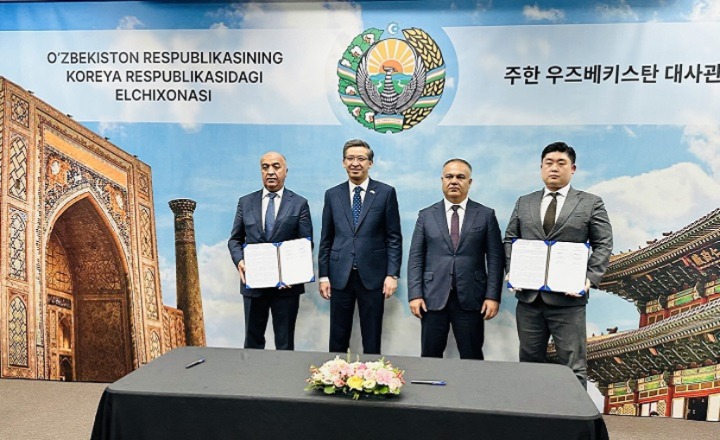
Samarkand participates in Uzbek-South Korea Business Forum, July 2025.
In July 2025, the acting governor of the Samarkand region, Adiz Boboev, gave a speech at the Uzbek–South Korean Business Forum to further promote economic potential and investment opportunities across agriculture, education, electrical engineering, mining, pharmaceutical, and textile industries. According to the official website of the Samarkand’s regional government, a number of bilateral documents were signed. Future business prospects include the expansion of the sectors in healthcare and urban infrastructure.
Culture and the Arts
In February 2025, the mayor of Samarkand, Fazliddin Umarov, welcomed the delegates from Gwangju, led by the director of the National Asian Culture Center, Kim San Guk. The visit by South Korean representatives was to reiterate the commitment mentioned in the friendship agreement and take a step toward the creation of “Samarkand’s Little Corner” in Gwangju’s ACC. The more recent and prominent cultural highlight is the opening of the international exhibition “Nomads on The Silk Road” at the National Asian Culture Center in November 2025. The exhibition’s aim was to showcase the cultural heritage that took its roots in steppes and oasis cities, like Samarkand, of Central Asia. It traces ancient routes of caravans that once passed over the Silk Road. The exhibition is structured in an intricate way that highlights the journey of merchants, the itinerant nomads, hopping from one caravanserais (lodgings) to another. Those nomads left physical traces by selling spices, exquisite fabrics, precious gems, and above all, folklore. A second type of nomads were the ones that talked to nature. They breathed in the wind and the quiet rhythm of the steppes. But their movements, nonetheless, had a profound impact on the Silk Road. The exhibition features miniature paintings, ceramics, colorful textiles and traditional carpets, nomadic horse carvings, music instruments, and even yurts. The great variety and complexity of the exhibits is a testament to Uzbek craftsmanship and its rich history.
“Nomads on the Silk Road” is organized in honor of The Year of Cultural Exchange between Uzbekistan and South Korea. Visiting this exhibition will allow the people of Gwangju to understand the national identity, historic continuity, and cultural heritage of the Uzbek people. The exhibition will run from Tuesday to Sunday every week until November 2027. The experience is available to the public free of charge and is friendly to all ages. As a token of appreciation and gratitude, the Uzbek delegates awarded the director of the Asian Culture Centre, Kim San Guk, with the honorary title of “Ambassador of Uzbek Culture.” This honorary title is proof of Director Kim’s dedication to cultural exchange between the two nations.
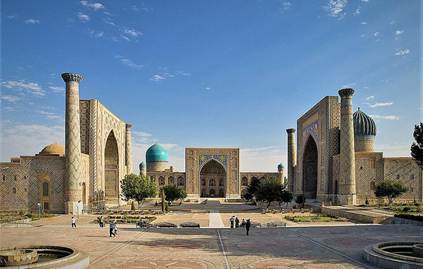
Registan Square in Samarkand, Uzbekistan. (Gustavo Jeronimo, MrPantyGoff; CC BY 2.0)
Education
In April 2025, a delegation from Gwangju TUIT (Tashkent University of Information Technologies). During their meeting, the delegation and the host explored the possibility of conducting joint international educational programs with hopes to build scientific potential for research, as well as exchange of students and educators, and organizing and hosting seminars and conferences to strengthen educational ties and encourage research collaboration. The potential expansion of the friendship agreement, between the two cities, beyond trade and manufacturing into the realm of education and research, further magnifies the ongoing success of this strategic partnership.
It is worth noting that South Korea and Uzbekistan have a strong economic relationship, the former investinghundredsofmillionsintovariousregions of Uzbekistan across automobile manufacturing, textile, infrastructure, technology, and overall modernization. As the world demands it, the strategic partnership between the two countries, Gwangju and Samarkand, is expanding towards green technology, digital innovation, and sustainable development.
The Author
Kamila Ismanova is a marketing professional based in Australia with a passion for creative storytelling and meaningful communication. She enjoys turning ideas into engaging campaigns and content. Outside work, she loves getting lost in a good book, practicing Pilates, and exploring new places around University visited the Samarkand branch of the city.
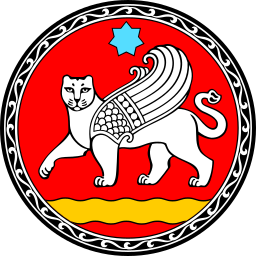
Cover Photo: Emblem of Samarkand.