
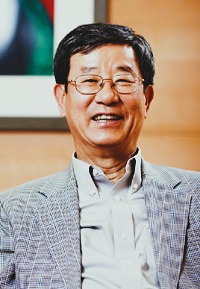
Inside the Gwangju News: Professor, Researcher, Administrator – Park Nahm-Sheik
For the past three years you have seen the name “Park Nahm-Sheik” appearing as the byline to the Ponderings and Contemplations column. Many of his writings reflect back on the many years he has to look back on; others look forward, pointing in directions to proceed. Prof. Park was one of a select few who were allowed to leave the country for graduate study abroad, and it was Park who shattered Seoul National University’s glass ceiling barring non-SNU graduates from SNU faculty positions. For more on this fascinating local standout, we offer you this interview with this member of the Gwangju News family. — Ed.
Gwangju News (GN): I wish to express my gratitude, Prof. Park, for you providing time for this interview. To begin with, you are a product of the Gwangju-Jeollanamdo area. Could you tell us about your early years as a boy growing up in the area and attending Chonnam National University [CNU]?
Prof. Park: In my younger years, I had abject hunger and poverty to wrestle with as did most youngsters of the era. For all the unpleasant experiences related to that time, I still retain plenty of nostalgia for the early-to-mid 1950s. Those tumultuous years might have hatched good fortune for my mid-to-late teens. Viewed from this perspective, everything may have been a blessing in disguise. For one thing, the tough times I went through while working my way through secondary school and college may have been instrumental in cultivating me into a sound and hardy tandem of mind and body. If not for those four years of challenging undergraduate work at CNU, the kind of academic achievements I attained later in my career may very well have been out of the question.
GN: Could you let us know a bit about your graduate studies overseas? That was at a time when it was extremely difficult for Koreans to be issued a passport for study abroad.
Prof. Park: With the support of CNU Professor Hong Sun-tak and General Lee Jun-hak, commander of the 31st Reserve Division in the Gwangju area, where Prof. Hong helped me get stationed, I became quite fortunate. I was able to obtain a generous grant to the University of Hawaii (UH) at Manoa and the East-West Center (EWC) in Honolulu, in the summer of 1965. It made me happy as a lark. In retrospect, I feel entitled to some bragging rights for a couple of things related to my time in Hawaii. First, I was one of only two top scorers on an English-language proficiency test administered jointly by UH and the EWC. I also was a straight-A student throughout the two-year master’s program at UH.
GN: I am amazed at your English proficiency, knowing that when you were young and learning English in secondary school, there were scantly any language learning materials available other than a teacher, a textbook, and a blackboard. Cassette tapes and tape recorders were not even available yet, were they?
“My eight-year stint at IGSE represented probably the happiest years of my ELT career.”
Prof. Park: As for the fundamentals of my English fluency, I owe much of it to a humble shortwave radio set I had long owned and which served as my English teacher from the beginning of high school in 1955. I made it a rule to listen to several major English-language broadcasters originating in the United States, Britain, and Australia. I also tuned in to other prominent global broadcasters such as Radio Moscow, Radio Peking, and Radio Japan. My favorite by far, however, was AFRTS (the Armed Forces Radio and Television Service of the United States). The station, based in Los Angeles, specialized in distributing batches of major news items to U.S. military bases throughout the Asia-Pacific region. Thanks largely to this station, I got to be so good at English that even my high school English teachers wanted to emulate me.
Comprising a half-hour program, the entire package of the day’s news on AFRTS was read at normal speed first. Then the same content was presented again at a distinctly leisurely pace, which was then followed by a dictation-style rendition. The whole thing was then read phrase by phrase for the listener to write it down. When I got sufficiently accustomed to this procedure, I repeated after the news reader instead of simply putting the words down on paper. This turned out to be a highly efficient way for me to learn to articulate, enunciate, and pronounce American English with amazing accuracy. And I enjoyed the process in its entirety.
GN: After returning to Korea from your U.S. graduate studies, you were able to obtain a position on the faculty at Seoul National University – the top-ranked university in the country, and you were the very first person in the English Department there from outside SNU or Seoul, I believe. That was at a time when one needed to be part of an in-group to succeed. How easy, or how difficult, was it for you?
Prof. Park: Dean Lee Han-bin and Professor Jo Jun-hak of SNU were extremely helpful. They had both been at UH for several of the semesters that I was there. Prof. Jo started the process of my faculty appointment with Dean Lee shepherding the rest of the SNU-internal administrative procedure for formal faculty appointment. The appointment finally came to a successful conclusion, though my supporters did run into stiff resistance from the SNU powers that be. I ended up clearing the hitherto seemingly impenetrable employment barrier constructed against non-SNU graduates of domestic institutions in Korea.
GN: Would you tell us about your years at SNU and serving at the Language Center?
Prof. Park: Frankly, there was lots of discrimination against me while at SNU on account of my hometown being Gwangju-Jeonnam and my alma mater of CNUbeing outside of the Seoul circle. My SNU tenure, however, was not all that grim. I enjoyed the privilege of being a protégé of a former SNU president, Kim Jong-eun. Under his tutelage, I got to serve multiple consecutive terms as executive director of the Language Research Institute, the most prominent research organization on campus, which expanded into the current Language Education Institute (LEI) in 2001. I turned it into SNU’s premier money-making research center in a matter of years. In this way, I was able to give back to the university what it had given to me. I take pride in having made a significant contribution to SNU by helping the institute to evolve into the university’s most profitable facility.
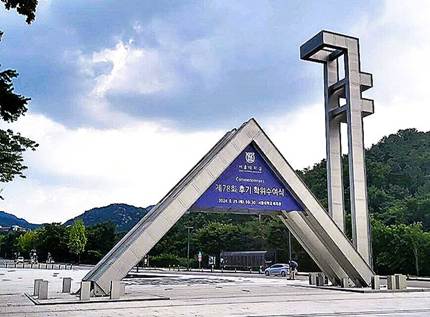
Seoul National University main gate. (Wittawat Mongkolnavasathien, CC BY-SA 4.0, detail)
GN: After your retirement from SNU, you became the president of the International Graduate School of English (IGSE) in Seoul. What was it like to be part of that institution?
Prof. Park: My eight-year stint at IGSE represented probably the happiest years of my ELT [English language teaching] career and possibly the final glory of my sojourn on this planet. I so enjoyed being in one-on-one daily contact with the staff, the student body, and the faculty. I sincerely appreciated the personal impact I was having on every member of the IGSE family. My daily IGSE routine got under way at around 10:00 in the morning with Words to Live By sent out on the school intranet. Every entry was popular on campus and off for the wisdom imparted therein and the compact idiomatic phrases that it so succinctly featured. Much of my popularity while at the helm of IGSE rode on this Words to Live By column and the accompanying wisdom-packed series of compact essays.
GN: Do you still have a bucket list of things to do? I imagine that over the years, you have been able to cross off many of the items that were once on that list.
Prof. Park: Let me say here that it doesn’t seem to be time yet to talk about my bucket list. I am not yet ready to kick the bucket. You know what I mean? Regardless, titles like “The Story of My Life,” “My Memoir,” “My Confessions,” etc. are among the things I wish to write before long and leave behind when I take leave of this planet. I am already running out of time, which is of the essence. Time flees away without delay, as they say!
GN: What is your opinion on the role of the Gwangju International Center, the Gwangju News’ parent organization, in the Gwangju-Jeollanamdo area. Do you have any advice to give?
Prof. Park: The GIC has an all-important role to play in the rapidly globalizing times we now live in. Multiculturalism, interculturalism, or cross-culturalism is the name of the game everywhere, not just in the Gwangju-Jeonnam region but the world over. Many of us have been turning a blind eye on this trend coming our way. With so many internationals among us, we simply cannot afford to ignore the trend.
GN: In concluding this interview, is there anything that you would like to say to our readership?
Prof.Park: I should like to sign off by expressing my gratitude to the Gwangju News for coming up with the idea of an interview with me.
GN: And on behalf of the Gwangju News, I would like to sign off by expressing our gratitude for your continued writings for our magazine and by wishing you good health and much happiness for many years to come.
Interviewed by David Shaffer.
Cover Photo courtesy of Financial News.