

Inside the Gwangju News: The Calcuttan with a Cause – Reeti Roy
Those of you who read the Gwangju News regularly have seen this name quite often over the past year. Reeti Roy pens our Calcuttan in Korea column and authors additional monthly articles on a variety of topics from art to education to governance with her unique inner eye. Here we bring you this issue’s interview with Ms. Roy. — Editor
Gwangju News (GN): I’d like to begin by thanking you for making time for this interview, which coincides with your travel plans, and by asking you to give us a little background information on your earlier days before Gwangju and the Gwangju News.
Reeti: I grew up in Calcutta and studied English literature at Jadavpur University. At 21, I moved to England and studied social anthropology at the London School of Economics. Moving away from home at that age was very formative. Literature had taught me to pay attention to language, narrative, and ambiguity; anthropology taught me to look at people and societies in context.
While I was in England, I volunteered as a playworker with the British Refugee Council, working with refugee children. That was one of my earliest encounters with questions around migration and social justice in a very direct way. You can read about asylum policy as an abstract political issue, but when you actually spend time with refugee children, the human dimension becomes impossible to ignore.
When I returned to India, my work moved between research, public policy, education, and development. I became a LAMP Fellow and worked as a legislative assistant to Shashi Tharoor, and subsequently worked with organizations including Pratham, the Harvard Business School India Research Centre, Columbia Global Centers, and UNICEF. Eventually, I founded Aglet Ink in 2014. So, if you look at the trajectory on paper, it can seem quite eclectic. But to me there has always been a thread running through it: an interest in people, institutions, ideas, and the stories we tell about them.
GN: And how did your work in Parliament influence you?
Reeti: It taught me how much work happens behind the scenes of public life. During my time as a LAMP fellow and legislative assistant, I was doing research, drafting parliamentary questions, Zero Hour interventions, private members’ bills, speeches, and press material. The subjects could be incredibly varied, from education and migration to gender and diversity. What mattered was learning to understand an issue properly before trying to communicate it. It also taught
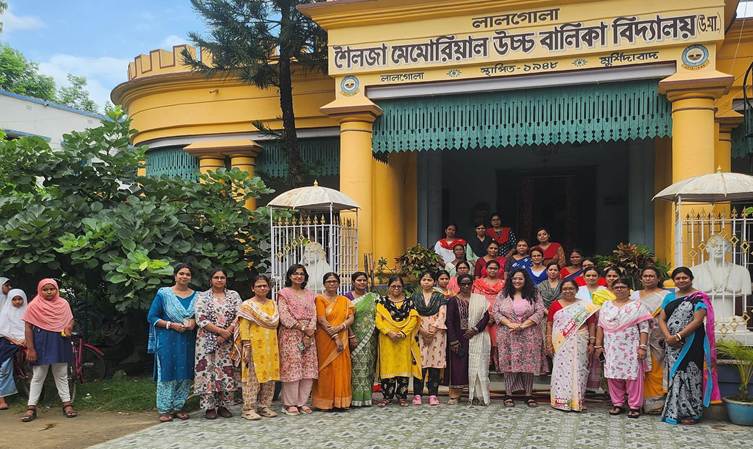
Reeti (center) with teachers at Shailaja Memorial Girls Higher Secondary School, Murshidabad.
GN: You eventually founded Aglet Ink. How did that transition happen?
Reeti: Quite organically. I realized that much of what I had been doing throughout my career involved interpreting information and helping people communicate it. Aglet Ink began in 2014 as a strategic and editorial advisory firm. A significant part of my work is helping people articulate their professional lives through CVs, LinkedIn profiles, and career narratives. It sounds very different from my earlier work, but I don’t actually experience it that way. Whether you’re helping someone articulate a career or researching a policy question, you have to listen carefully, identify what is significant, and distinguish substance from noise.
GN: How did your connection to Korea evolve?
Reeti: Korea was in my life much earlier than my own travels here. My father lived in Korea for about two years in the 1980s and worked for Samil Accounting Corporation, which was the name used for PwC Korea. When I was about three, he would make kimchi at home, so I grew up eating it. This was long before I knew anything about the Hallyu wave. Korea wasn’t something I encountered first through K-pop or Korean dramas. I knew it through my father’s stories.
As a child, Korea felt almost dreamlike to me. It was this distant place that had been part of my father’s life. So there was something quite strange and lovely about eventually coming here myself and discovering the country behind those stories. But I think it is important to distinguish between inheriting an awareness of a place and developing your own relationship with it. My relationship with Korea has since been built through my own experiences – through living here, learning the language, making friendships, teaching, writing, and researching.
GN: I think your first approach to the Gwangju News was through an email to me. What created your interest in our magazine?
Reeti: I was drawn to the Gwangju News because it is rooted in an actual community. I wasn’t looking for somewhere to produce generic travel writing about Korea. I’m interested in what happens when you stay somewhere long enough to notice things that aren’t necessarily part of the tourist narrative. The ordinary details of a city can tell you an enormous amount about its history and its people. And I liked the possibility of writing about Korea from an Indian perspective without making every piece explicitly about “India versus Korea.” Sometimes the comparison is there simply because I am the person looking.
GN: The title of this interview was created only partially for its alliterative effect. I believe that you have more than one cause that you feel strongly about.
Reeti: I do. I’m interested in social justice, migration, education, cultural memory, and questions of belonging. I’ve always been particularly interested in people who find themselves between categories – migrants, refugees, people living between countries, people who don’t fit neatly into professional or cultural boxes.
Education is another important part of that. Through the Biren Roy Foundation, where I am a trustee, I’ve been involved in work in Lalgola, Murshidabad, where my family has deep roots.
One project particularly close to me has been a library initiative for a government girls’ school serving around 4,000 students. We organized a nationwide book donation drive to help build up the school’s library. I love the idea that something as simple as a library can quietly alter the horizon of a young person’s life. You aren’t only giving someone books. You’re giving them access to worlds they may otherwise never encounter.
GN: Is that how you understand social justice – as something that can operate through relatively small interventions?
Reeti: I think social justice has to exist at both scales. There are obviously structural questions – law, policy, inequality, migration, access to education. But there is also the question of what you actually do with your own time and resources. I’ve never been particularly interested in announcing that I have a cause. I’d rather work on something and let the work speak for itself.
GN: In your author bio in the Gwangju News, you refer to yourself as a cultural commentator. Is this in reference to your causes, or is it a reference to other areas of professional interest? Or is there overlap?
Reeti: There is a lot of overlap. I’ve always been interested in the space between disciplines. My professional life moves between business, writing, research, and education, while my intellectual interests move between anthropology, literature, cities, migration, and culture. I don’t think cultural commentary necessarily means having an opinion about everything. For me, it means paying attention to the cultural assumptions underneath things that we often take for granted.
GN: You have been giving invited lectures at universities and institutions in a variety of countries. Could you tell us about where you have spoken and what the talks have covered?
Reeti: What I find most interesting is that I often end up speaking to audiences outside what might conventionally be considered my discipline. At Ewha Womans University, I was invited for an Architecture and the City lecture, where I spoke on “Justice and the City: Refugees, Children, and Urban Life.” That brought together questions of urban space with my earlier experience working around refugees and vulnerable communities.
At Pusan National University, I spoke to the Department of Global Studies on “Experts of the In-Between.” That is a subject particularly close to me – the idea that there is a kind of expertise that comes from living and working between cultures, disciplines, and systems. At Chiang Mai University, I spoke to the Department of Social Science and Development about migration and human mobility.
I’ve also spoken in cultural settings about art, literature, memory, and cities. I actually like the fact that these audiences are so different. Architecture students will ask different questions from social science students. A global studies classroom will look at a problem differently from a cultural audience. Those differences make the conversation much richer.
GN: You’ve spent several periods of time in Korea in recent years. What were the purposes of those stays? And you’re just beginning a new one!
Reeti: For the past thirteen years, my primary home has been Bombay, although my work has always meant that I spend a great deal of time in Delhi and Calcutta as well. I was used to traveling for work – an occasional five-day trip here, a week there, usually with a very clear purpose and a return ticket. Over the past year, that changed quite dramatically. What had once been an occasional five-day work trip became months and months abroad. Instead of moving between Indian cities, I found myself moving between countries, often staying long enough for a place to stop feeling like a destination and start becoming part of my everyday life.
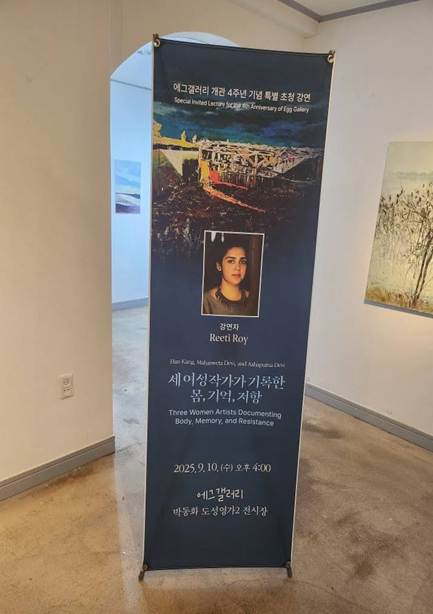
At Egg Gallery in Yeosu, Jeonnam-Gwangju.
I was in Chiang Mai quite recently, and that felt oddly like home, too. I think that’s something I’ve become increasingly aware of: Home doesn’t necessarily have to be a single geographical point. Sometimes it is a rhythm, or a familiarity, or simply the feeling that you know how to move through a place. Korea has been particularly important in that process. I’ve been here for writing, research, teaching, and cultural work, but also simply to live here and see what happens when you give yourself enough time to get beyond the obvious version of a place.
And this time I’m returning in a rather different capacity. I’ll be in Wonju as an overseas artist at the Toji Cultural Foundation. That’s particularly meaningful because it gives me something that constant movement doesn’t: sustained time to write and think. There is also something rather lovely about the trajectory.
Korea was a dreamlike place in my childhood because of my father’s stories; later, I came here independently and developed my own relationship with the country; now, I’m returning as a writer, with a period specifically devoted to creative work. I think I’m increasingly interested not simply in traveling but in what happens when you stay somewhere long enough for it to become complicated – and familiar.
GN: You’ve told me that you divide your life equally into three areas of endeavor. Could you elaborate on that for us?
Reeti: I think of it as one third for work, one third for adventure, and one third for social justice. Work is Aglet Ink: writing, teaching, and research. Adventure is travel: learning languages, living in unfamiliar places and saying yes to experiences that I can’t completely predict. And social justice is the part of my life that takes me outside my own immediate concerns: my interest in migration and refugees, education, and projects like the library initiative in Murshidabad.
I don’t actually think these are three separate compartments. Ideally, they feed each other. Adventure keeps me curious. Work gives me independence. And social justice keeps both from becoming too inward-looking.
GN: Now, to get more personal in my questioning. I’ve seen in your KakaoTalk profile that your photo is that of a kitten, and one of your articles for the Gwangju News featured a tuxedo named Finesse. How attached are you to the fuzzy felines?
Reeti: Extremely. Finesse is one of the great constants in my life. And there are now a few more little kittens living with my parents in Calcutta, so the feline population has expanded considerably. Finesse is also entirely unimpressed by anything I might consider an achievement, which is probably healthy for me. You can spend an entire day thinking about work, publications, or professional ambitions, and then come home to Finesse, whose principal concern is whether dinner has arrived. There is something wonderfully grounding about cats. They don’t care about your résumé. They just require you to be present.
GN: You’ve been quite prolific recently in writing for the Gwangju News, often two articles per issue, including your column, The Calcuttan in Korea. Where do you find the time for all this writing?
Reeti: I don’t really wait for inspiration. I take notes constantly. I’ve been journaling since I was five, and I have notes everywhere. I am always writing. I notice conversations, places, gestures, small contradictions. When you’re living somewhere unfamiliar, there is material everywhere if you’re paying attention. And I think writing becomes possible when you stop treating it as something that requires perfect conditions. You sit down and do it. The difficult part isn’t finding things to write about. It’s deciding what deserves to become an essay.
GN: What future plans do you have for yourself – both short-term and long-term?
Reeti: In the immediate future, I want to give myself more uninterrupted time for writing. Toji is important to me for precisely that reason. I also want to continue developing the India–Korea strand of my work but without turning it into a formula. I don’t want to become someone who simply repeats the same observations about Korea.
Longer term, I want to write a book and continue moving between writing, teaching, cultural work, and travel. I’m increasingly comfortable with not having a perfectly mapped-out career. I think some of the most interesting things in my life have happened because I left room for them.
GN: In concluding this interview, is there anything that you would like to say to our readers?
Reeti: Stay curious, and spend enough time somewhere to let it contradict your assumptions about it. I think that’s one of the great gifts of living somewhere else. You arrive with an idea of a place, and if you’re lucky, the place gradually becomes much more complicated than the idea. That’s when you really begin to know it.
And to you, our editor-in-chief, thank you. It has been such a pleasure to write for the Gwangju News, and an even greater pleasure to have these conversations with you. I’m very grateful for the warmth with which you have welcomed my work and given me the space to explore these ideas. I hope there will be many more conversations to come.
GN: Well, thank you for the thank-you. And thank you for sharing with us these many interesting aspects of your life and the many interesting articles you have shared with the Gwangju News. I’m sure there will be many more of both in the future.
Interviewed by David Shaffer.
(Photographs courtesy of Reeti Roy)
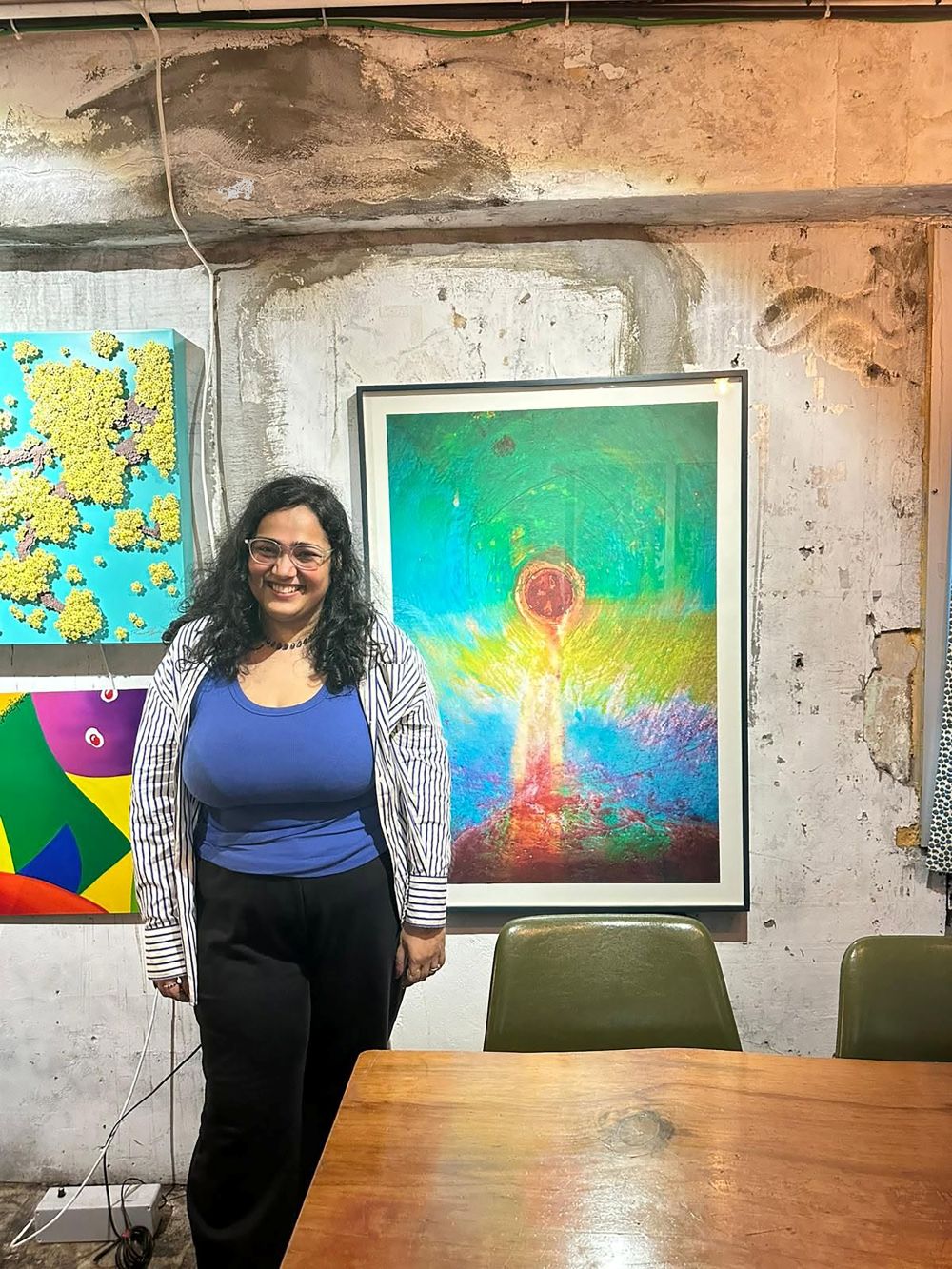
Cover Photo: Reeti at the KOTE cultural and arts complex in Insa-dong, Seoul.