
Yangnim’s Got Biennale Pavilions!
By Chung Hyunhwa ||
The 2026 Gwangju Biennale suddenly felt real when an artist and a curator booked to stay at my AirB&B to participate in the event. This prompted me to go visit their exhibit.
This year’s Gwangju Biennale has 10 pavilions situated in the Yangnim-dong area, away from its main exhibition hall in the Buk-gu district. At Yangnim Art Center near Sajik Park, I met our guests, Luis Enrique and Silvana Lagos at the Peru-Uruguay Pavilion on opening day. I had the luck of meeting two additional artists there also to hear about their displays.
Luis Enrique Zela-Koort from Peru was collaborating with another Peruvian artist, Alonso Leon-Velarde under the title of “At the Threshold” for this show. Luis had a northern European look with his blond hair and blue eyes. He spoke fast, and his eyes sparkled with passion when talking about his art. His sculptures on display were his AntiProduction Series. They were gigantic “industrial transmission gears moving at a slow, unrelenting, other-worldly rhythm,” according to the brochure description. What I noticed was that the gears were composed of metal axes and terracotta ceramic teeth, which were producing terracotta dust beneath them as they moved, due to abrasion caused by friction. It showed the paradox that the gears were built for production but that they also consumed themselves to achieve “antiproduction.” According to Luis, the ceramic parts symbolized the technologies that have existed since pre-historic times, while the metal parts represented modern technologies. He offered, “Technologies do not forget the past.”
He smartly designed the terracotta teeth to wear away at different speeds by firing them at various temperatures, but even careful calculation could not fully control the abrasion, so it would occur in unpredicted ways. Just like life. For the 72 days of the Biennale, the gears will run to keep grinding down, and in the end, most of the terracotta teeth will disappear, as if all living things return to dust.
Luis thinks that what happens to these mechanical objects is rather “human.” Nothing remains the same. He also designed them to sound differently when spinning. He intended them to function as percussion instruments to make music together by running at different speeds.
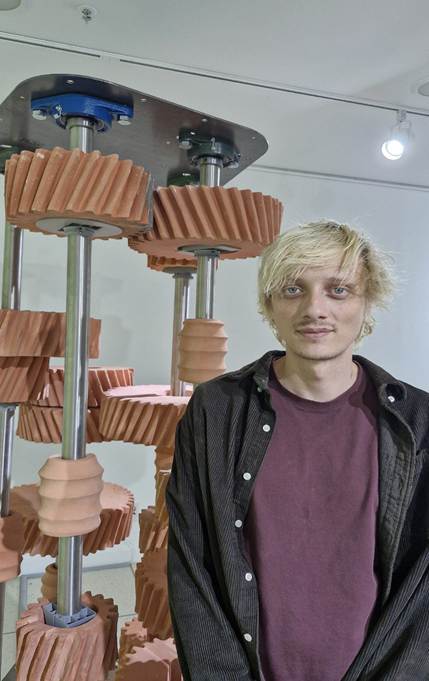
Artist Luis Enrique from Peru.
I asked Luis if there is a theme that threads through his artworks. Luis answered, “Possibilities and relationships.” He questioned why ceramics could not be used for the metal gears. He was open to exploring every possibility and considering the relationships among things. He never seemed to accept anything that many of us take for granted without questioning it; instead, he seemed to want to convince us that we should question those assumptions as well.
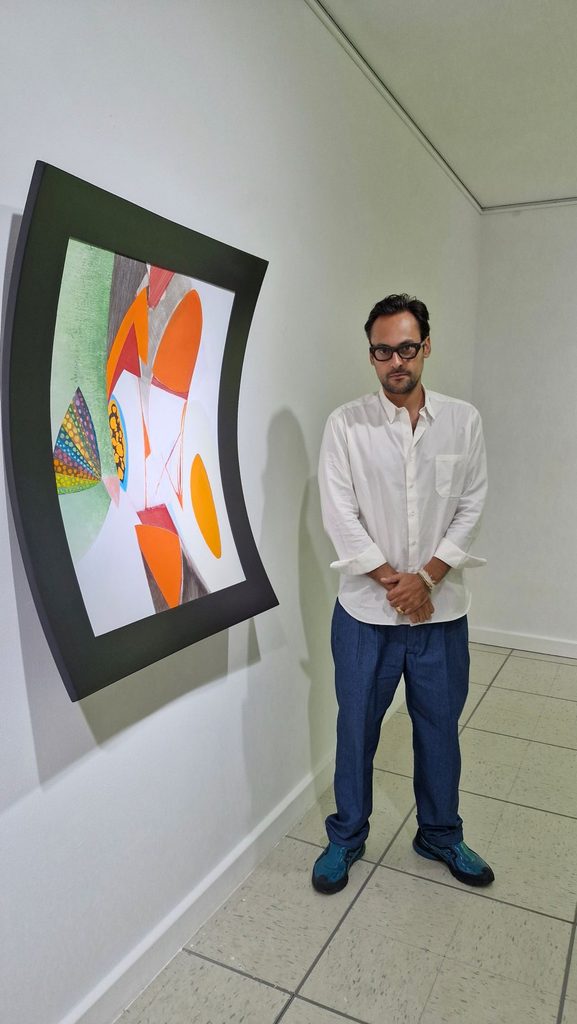
Artist Alonso Leon-Velarde from Peru with his art piece.
On the same floor, I also met Alonso Leon-Velarde. He had black hair and was wearing glasses. He introduced himself saying that he had been studying and working internationally and that he was displaying three vivid oil-paintings in this show, each using different techniques. In the brochure, I read, “His Vision Paintings approach a different kind of threshold, the space between the earthly and the spiritual, the observable and the hallucinatory.” Alonso said that the images in his abstract paintings reflected the visions that he perceived in his mind. They could vary from mirages he observed to religious visions, following the visionary painting traditions. Although Alonso’s paintings seem to be far from Luis’ mechanical AntiProduction in medium and method, they were both “at the threshold” between matter and imagination, and between ancestral knowledge and speculative futures,” to again borrow the wording in the brochure.
On my way out, I met another artist, Diego Masi from Uruguay with Lukas Kühne, a German curator working with him. Diego’s three artworks were installation art under the theme “Territorium.”
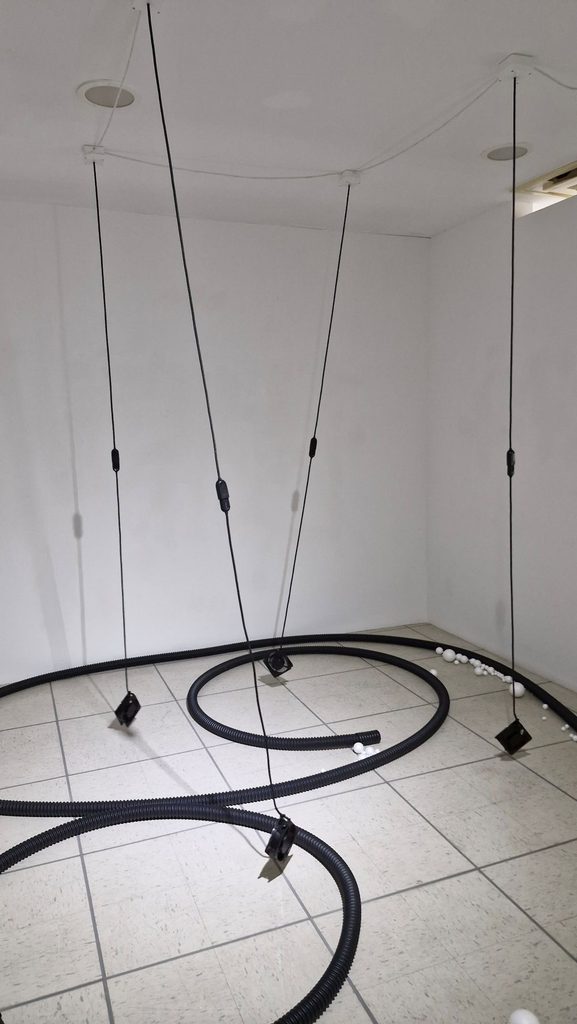
Diego Masi’s work.
The first art piece was a small briefcase on the wall, playing recorded messages saying that freedom should be ensured. One visitor to the gallery asked if the embassy supported their attending this Biennale when his artworks were rather political. He said yes, and explained that Uruguay achieved democracy. As a Korean national, freedom seemed to have been naturally given and felt like air around us, but thinking again, I realized it had not been so long ago that we started to have our full freedom, and we did not get it for free, either. There are still countries in the world where freedom is something that is strongly wished for, as the briefcase pleaded. I thought it was really nice to see the visitors talking with the artists on opening day in front of their artworks.
Diego also had two installations on display. One room displayed a lot of speakers on the wall in a nice visual pattern. If you put your ear close to the speakers, you can hear the recorded voice of a singer, Anibal Sampayo, who was prisoned in 1972 under Uruguay’s then military dictatorship. As a person from Gwangju, I felt I already knew what the singer was saying, even though I didn’t understand the Spanish he was using. The other installation used computer fans, which dangled over black flexible pipes. The pipes were supposed to represent territory, and the fans were to be drones flying over it. While watching the dangling fans, I thought about what the territory was that the artist intended for us to think of.
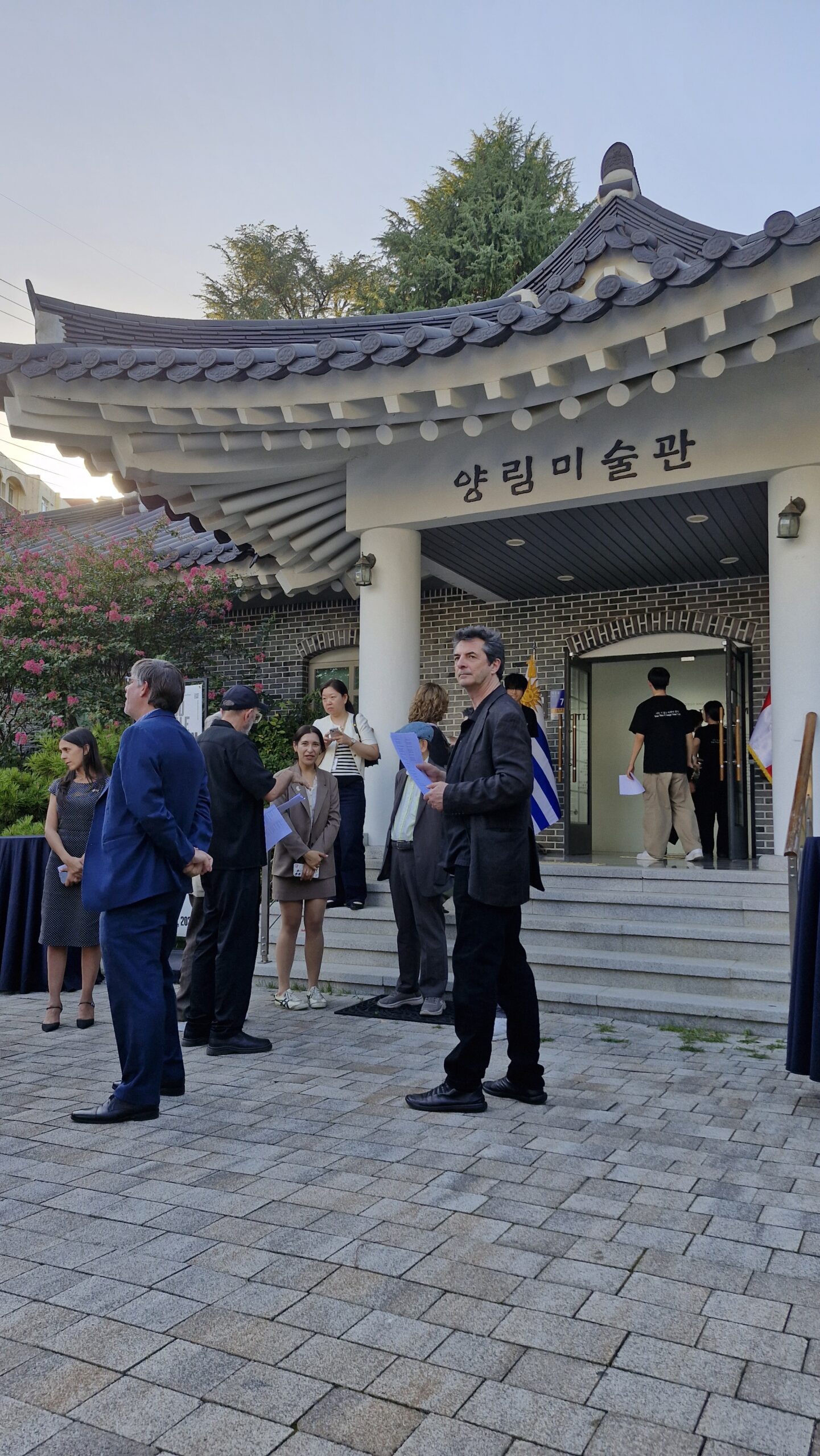
The opening reception was to begin at the end of the day in front of the gallery. The gallery was in the traditional Korean hanok building style, so I thought it well suited for such an occasion. The pink crape myrtle flowers bloomed with grace at the entrance to the building, and the air had just started to shake off the summer heat. It was one fine day to find people from anywhere were not that different, and we had a language that we could communicate in without saying anything. I hope you can also find some time to explore the pavilions in Yangnim-dong, while enjoying the fall atmosphere.

Guided Tour Information
There are guided tours for the 10 pavilions in the Yangnim-dong area, from September 18 until November 14. Go to Naver Booking for the Biennale Exhibition Tour. 10,000 won includes the tour and a 5,000-won coupon for the local stores. What a deal! Use the QR code for reservations.
The Author
Chung Hyunhwa, a native of Gwangju, recently worked for a local horticultural company. She led the international eco-hike group Gwangju Hikers at the GIC in 2020 and 2021. Previously, she taught English at Yantai American School and Yantai Korean School in China and worked in school administration at Branksome Hall Asia in Jeju. She holds a master’s degree in TESOL from TCNJ in the U.S. and has a license to teach Korean. She loves plants, birds, dogs, and repurposing items creatively.
(Photographs by the author)
Cover Photo: Yangnim Art Center on opening day.