



The InnoCORE Project: Investing in the People Who Will Shape Korea’s Scientific Future
By Saqib Sharif ||
How a new national research initiative is building the next generation of scientists and connecting Korea’s strategic technologies with Gwangju’s growing research ecosystem.
South Korea has built its economic success on technology. From semiconductors and automobiles to biotechnology and advanced electronics, Korean industries have repeatedly transformed scientific discoveries into products that reach the world. But the next technological race will be different. Artificial intelligence, quantum technology, advanced mobility, biotechnology, future materials, and other emerging fields are developing rapidly, often crossing the boundaries between traditional disciplines. To remain competitive, Korea needs not only better technologies but also a new generation of researchers capable of working across these boundaries.
This is the idea behind InnoCORE (“innovation” + “core”), a national initiative designed to strengthen Korea’s strategic technology capabilities by putting outstanding postdoctoral researchers at the center of research. This project aims to establish a new model of group and interdisciplinary research, connect universities with government-funded research institutes, nurture future research leaders, and expand Korea’s pool of highly skilled scientific talent. Its name reflects the central idea: developing the core researchers who can drive innovation in strategic technologies. The project covers fields ranging from AI and semiconductors to biotechnology, quantum technology, advanced mobility, energy, the environment, and future materials.
“To remain competitive, Korea needs … a new generation of researchers.”
But a national venture becomes meaningful through the places where it is put into practice. One of those places is Gwangju. At the heart of Gwangju’s science and technology ecosystem is the Gwangju Institute of Science and Technology (GIST). For years, GIST has been developing research strengths in areas that are now becoming central to Korea’s technological future. Through InnoCORE, the institute is taking on a new role: not simply conducting research but creating a collaborative environment where young researchers, university faculty, government-funded research institutes, hospitals, and international partners can work together on complex problems.
In 2026, GIST launched several InnoCORE research projects, including both GIST-led research groups and projects connected with government-funded research institutes. InnoCORE is explicitly designed around postdoctoral researchers as key research personnel. The result is something larger than a collection of research projects. It is an attempt to build a research ecosystem.
From a National Vision to a Gwangju Opportunity
For Gwangju, this matters because the city already has many of the ingredients needed for such an ecosystem. GIST provides advanced scientific research and international connections. Chonnam National University and its medical facilities provide another important research base. Government-funded institutes and tech companies add specialized expertise and pathways toward practical applications.
(Poster detail, GIST InnoCORE)
InnoCORE can help connect these pieces. Consider the range of questions being explored: How can artificial intelligence help identify diseases earlier? How can nanotechnology improve medical diagnostics? How can advanced materials support future devices? How can microfluidics, robotics, and digital technologies be combined to solve healthcare problems? These are not questions that belong to a single laboratory. They require physicists to work with engineers, engineers to work with biologists, AI researchers to work with doctors, and young researchers to learn how to communicate across disciplines. That is precisely where the value of InnoCORE becomes visible.
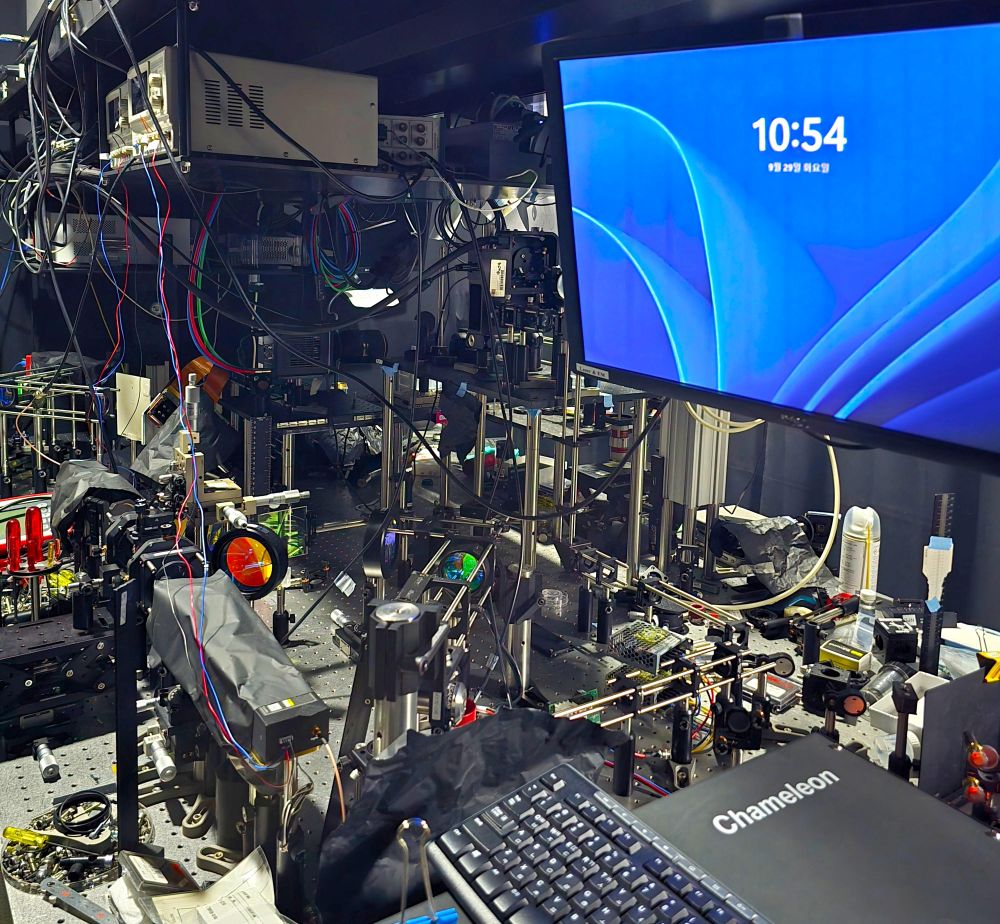
Optical setup for high-resolution brain microscopy and imaging experiments in a GIST InnoCORE lab. (Saqib Sharif)
At GIST, for example, the Ignite InnoCORE research group is building research around global infectious-disease response technologies. It combines microfluidics, microparticle manipulation, blood separation, computational fluid dynamics, and topology optimization, while also providing connections to international researchers and industry. The current fellowship model is planned to run from 2026 to 2030, with 25 elite postdoctoral positions as its initial target and a longer-term goal of nurturing 50 researchers.
“[InnoCORE] is an investment in research but also in people.”
REMAP (Reprogramming Metabolism and Plasticity) is a GIST InnoCORE project led by Professor Euiheon Chung in collaboration with KIST (Korea Institute of Science and Technology). The project explores ultra-high-frequency magnetic stimulation as a potential new approach to understanding and treating Alzheimer’s disease. By bringing together magnetic stimulation, neuroscience, brain metabolism, and biomedical engineering, REMAP reflects the interdisciplinary research model that InnoCORE is designed to promote. More importantly, it gives young researchers an opportunity to work on ambitious healthcare challenges while connecting GIST’s research capabilities with national and international scientific networks.
Another GIST InnoCORE initiative is bringing AI and nanotechnology together for early diagnosis of brain diseases. Such projects demonstrate why interdisciplinary research is becoming increasingly important. The most important scientific problems are rarely confined to one field.
For Gwangju, this creates an opportunity to position the city not only as a place where researchers work but as a place where different kinds of researchers work together. And that may ultimately be the most important impact of InnoCORE.
Research funding is often measured in familiar numbers: the amount invested, the number of projects, publications, patents, or technologies developed. InnoCORE deserves to be viewed through another measure as well: the people it develops. A postdoctoral researcher joining an InnoCORE group today may become a professor, research leader, entrepreneur, or industrial scientist tomorrow. The skills developed during these years can travel far beyond GIST and Gwangju. InnoCORE therefore represents a long-term investment. It is an investment in research but also in people. It is an investment in collaboration, but also in the future identity of Gwangju as a science and technology city. And if this project succeeds, its most important discoveries may not be the ones that appear first in a laboratory paper. They may be the researchers who go on to make the next discovery.
Sources
InnoCORE. (2026). GIST InnoCORE. https://www.innocore.or.kr/gist
REMAP. (2026). https://gistnpl.github.io/REMAP/
The Author
Saqib Sharif is a robotics engineer with a PhD in mechanical engineering, specializing in the design of smart healthcare devices and microrobots. With a strong background in medical technology and innovation, he is passionate about creating solutions that enhance smart healthcare. Dr. Sharif has been living in Gwangju for the past ten years. Currently, he serves as an InnoCORE research fellow at the Gwangju Institute of Science and Technology (GIST).
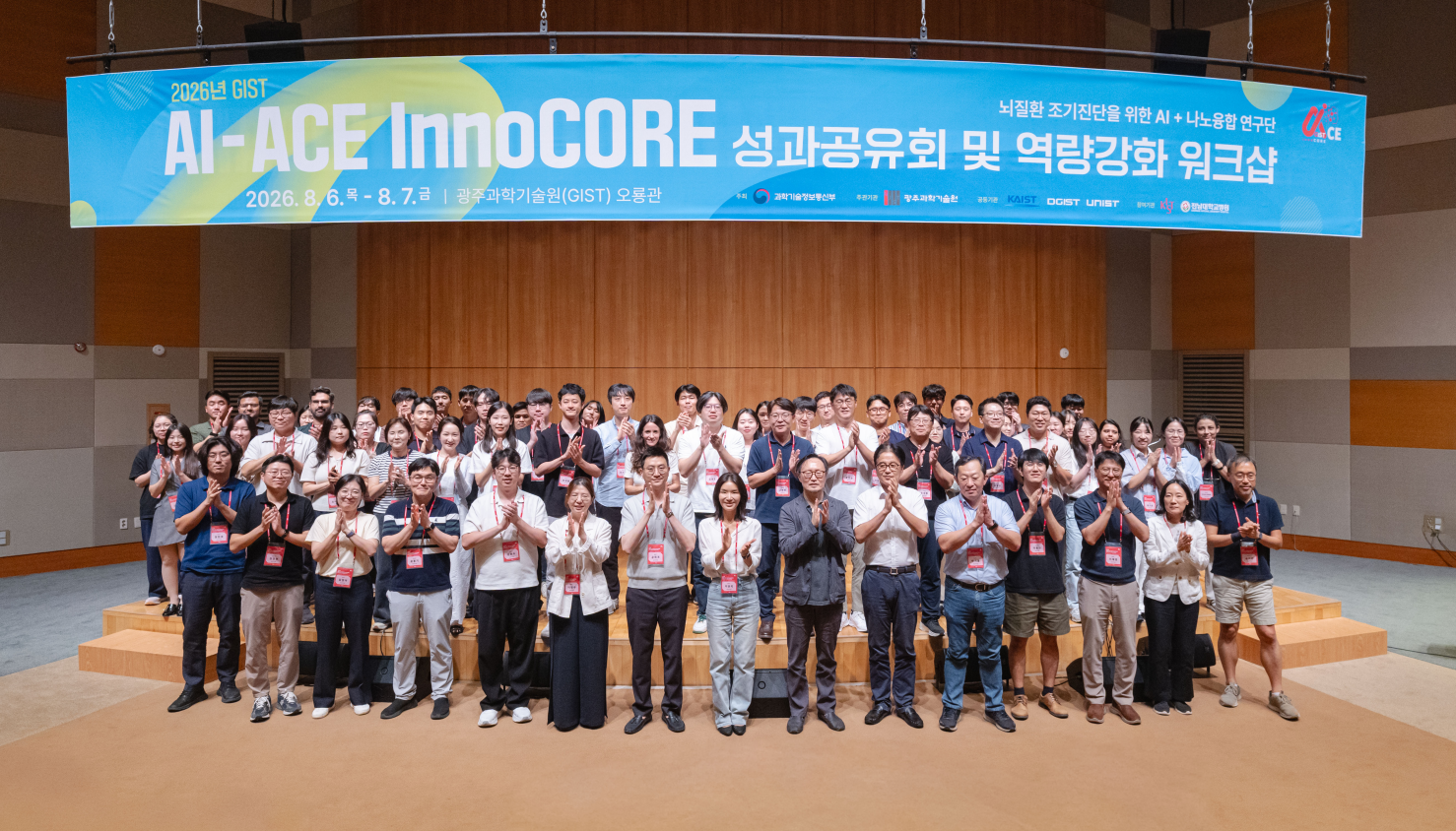
Cover Photo: GIST AI-ACE InnoCORE group holds 2026 milestone sharing and capability-building workshop, August 6–7. (GIST InnoCORE)