







When Machines Began to Dream: The Age of Artificial General Intelligence
By Muhammad Umar Tahir ||
For most of the history of computers, machines waited for us. We pressed a button, typed a command, opened a program, and told them exactly what to do. Even the smartest software remained a tool in our hands. But something is beginning to change. Today, an AI system can receive a goal, search for information, write documents, analyze data, create software, use digital tools, correct some of its own mistakes, and continue working through several steps before returning with a result. The machine is still following human direction, but it is no longer waiting for an instruction at eversingle step.
This change may be the beginning of one of the most important transitions in the history of technology: the journey from artificial intelligence toward artificial general intelligence, commonly known as AGI.
We already live with artificial intelligence everywhere. It recommends the next movie we might enjoy, translates languages, recognizes faces in photographs, writes emails, generates images, answers questions, and helps programmers create software. Yet most AI systems are still better at some tasks than others. A system can solve an extremely difficult mathematics problem and then make a surprisingly simple mistake. It can produce an impressive business plan but misunderstand an ordinary real-world situation. Modern AI can appear brilliant one moment and strangely confused the next. Researchers sometimes describe this as a “jagged” intelligence: extremely capable in certain areas but still unreliable across the full range of situations humans handle naturally.¹
AGI represents a much bigger idea. There is no single definition accepted by everyone, but in simple language, AGI usually refers to an artificial intelligence that can understand, learn, reason, and work across many different kinds of tasks rather than being designed mainly for one area. Instead of having one AI for writing, another for coding, another for science, and another for planning, an AGI could potentially move between these areas, learn unfamiliar tasks, connect different kinds of knowledge, and adapt much more like a capable human being.²
The difference is similar to the difference between a calculator and a person. A calculator can perform arithmetic faster than almost any human, but it cannot suddenly decide to learn Korean, organize a conference, understand a joke, design a house, or help solve a business problem. Human intelligence is general. We carry what we learn from one situation into another. AGI aims toward something closer to that flexibility.
This is why the current rise of AI agents is so interesting. Until recently, most people experienced AI through a simple conversation: Ask a question and receive an answer. Newer AI systems are increasingly able to use tools and carry out longer tasks. Instead of asking, “Which hotel should I choose?” a system might be asked to organize an entire journey within a budget. It could compare transport, study hotel locations, arrange a schedule, check possible conflicts, prepare a travel plan, and adjust everything when something changes.
The same idea can move into the workplace. Instead of asking AI to write one paragraph of a report, a person might give it a much broader goal: study a market, compare competitors, analyze company documents, prepare charts, identify unusual changes, and create a first version of the report. The human would still guide the goal and review important decisions, but much of the work between the beginning and the final result could increasingly be handled by the machine.
That is the meaning behind the phrase “when machines began to dream.” Machines are not literally dreaming like humans, and there is no scientific evidence that today’s AI systems experience dreams, feelings, or inner consciousness. The phrase describes something more practical: Machines are moving from simply responding to commands toward systems that can plan a path toward a goal. And that small change could transform almost everything.
Consider education. Today’s students can already ask AI to explain a difficult lesson. An AGI-like tutor could go much further. It might understand how a particular student learns, recognize which ideas are causing confusion, change the explanation, create personalized exercises, remember previous weaknesses, and continue adapting over months or years. Two students sitting in the same classroom could receive completely different learning experiences designed around their individual needs.
Healthcare could also become more personalized. An advanced general AI might help professionals connect information from medical research, patient history, laboratory results, medical images, and previous treatments. Instead of searching through many separate sources, doctors could work with an intelligent system capable of bringing relevant knowledge together. The important decisions would still require professional responsibility and human judgment, but the amount of information available to support those decisions could become far greater.
Scientific research may become one of the most exciting areas. Science often advances by making connections that were previously missed. A researcher may spend years becoming an expert in one field and still have limited knowledge of discoveries happening in another. A sufficiently capable general AI could study information across physics, chemistry, medicine, engineering, biology, and computing at the same time. It might help researchers identify patterns that humans working inside separate disciplines would not easily notice.
The scientist of the future may therefore work very differently. Instead of spending weeks searching literature or testing every possible direction manually, researchers could work with AI systems that suggest ideas, compare thousands of possibilities, run simulations, and help design experiments. Human curiosity would remain important, but the speed between asking a scientific question and exploring possible answers could become much shorter.
Businesses may experience an equally large change. Today’s companies are organized around people performing many separate tasks: writing emails, preparing presentations, checking accounts, studying customers, organizing meetings, analyzing information, and managing projects. AGI could connect many of these tasks. A future AI colleague might understand the overall purpose of a project rather than waiting for hundreds of individual instructions.
“Today’s AI still needs us far more than futuristic stories sometimes suggest.”
This does not necessarily mean that one morning every job disappears. Technology usually changes work in more complicated ways. Some tasks become automated, some jobs shrink, new roles appear, and the skills valued by employers change. When calculators arrived, mathematics did not disappear. When computers entered offices, office work did not disappear. But what people spent their time doing changed significantly.
AGI could create a much more significant version of this shift. If machines become very good at producing information, writing, analyzing, planning, and solving routine problems, human value may move increasingly toward deciding what should be done, not simply performing every step ourselves. Judgment, responsibility, creativity, communication, leadership, empathy, and the ability to understand real human needs could become even more important.
There is also another possibility that is easy to overlook. AGI may not arrive as one dramatic invention with a flashing headline saying, “Today AGI has been created.” It may arrive gradually.
A few years ago, talking naturally with an AI assistant felt extraordinary. Then AI began creating realistic images. It learned to generate video, write complex software, reason through difficult scientific questions, use computers, browse information, and perform longer tasks with less supervision. According to the 2026 International AI Safety Report, general purpose AI has continued improving especially in mathematics, coding, scientific reasoning, and autonomous operation, although today’s systems still make basic mistakes and remain unreliable on many longer tasks.¹
That uneven progress matters because AGI is sometimes discussed as if there were a clear line separating “ordinary AI” from “general intelligence.” Reality may be much less dramatic. Each generation of AI may simply become able to do a little more, remember a little more, work for longer, use more tools, and require fewer instructions. Eventually, society may look back and realize that the relationship between humans and machines had already changed before anyone agreed on the exact moment AGI arrived. The most visible change may be independence.
Today, we often ask AI questions. Tomorrow, we may increasingly give it objectives. Instead of “Tell me how to do this,” the request becomes “Take care of this and show me the result.” That is a very different relationship with technology.
A personal AI aide could organize schedules, prepare documents, compare purchases, monitor household expenses, plan travel, help children learn, and manage routine digital tasks. A company could have thousands of AI agents working alongside employees. A scientist could work with several AI research partners. Governments could use advanced systems to study transportation, energy, public services, or emergency planning.
At that point, intelligence itself begins to look different. Until now, advanced intelligence has always been connected to biological life. A skilled engineer has one brain and limited hours in a day. A doctor cannot read every new medical paper. A scientist cannot personally test millions of ideas. But a powerful artificial system could potentially work across enormous amounts of information at a speed and scale very different from human thinking. This is where excitement about AGI also becomes concern.
A system capable of doing more on its own can also make larger mistakes on its own. An incorrect answer from a chatbot can be inconvenient. An error from an autonomous system controlling important financial, industrial, medical, or digital processes could have much greater consequences. The 2026 International AI Safety Report notes that AI agents are becoming more capable but still make mistakes during complex, multi-step work, which is why reliability and human oversight remain important.¹
There are also questions of power. If AGI becomes one of the most valuable technologies ever created, who controls it? Will its benefits be available widely, or mainly to a small number of companies and countries? What happens when extremely capable AI systems compete with one another? How should governments create rules for a technology that may develop faster than traditional regulation? Perhaps the most difficult questions, however, will not be technical.
If an AI can write a beautiful novel, is creativity still uniquely human? If it can make scientific discoveries, how will we define intelligence? If it can teach, plan, design, negotiate, and solve difficult problems across many fields, what qualities will remain most important for us?
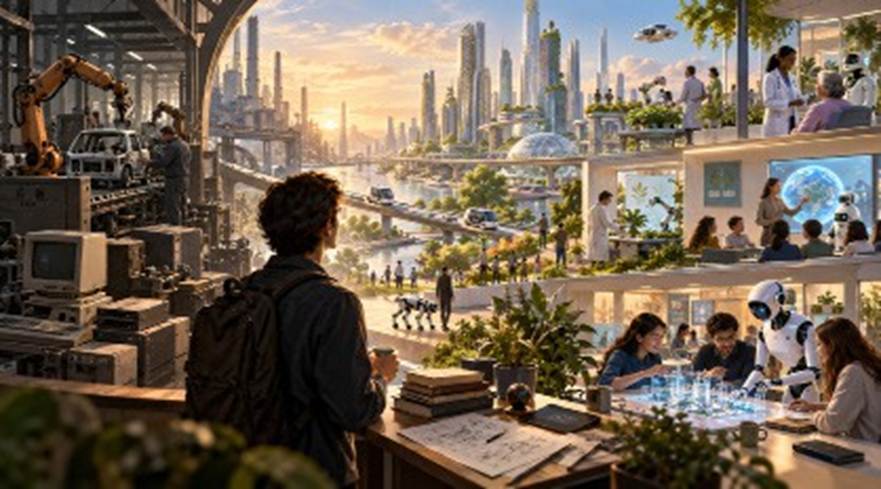
These questions do not mean that machines are becoming human. Intelligence and consciousness are not the same thing. A machine may become extremely capable without experiencing happiness, fear, ambition, or curiosity in the way humans do. We still do not fully understand human consciousness, and there is no established evidence that today’s AI systems possess subjective inner experiences.
“If an AI can write a beautiful novel, is creativity still uniquely human?”
So perhaps the age of AGI should not be imagined as a science fiction moment when a machine suddenly opens its eyes and announces that it is alive. The real transformation may be quieter. The machines may simply become increasingly capable of understanding our goals and finding ways to achieve them. That could be much more important than a dramatic robot awakening.
For centuries, humans built machines mainly to increase physical power. Engines became stronger than muscles. Cars moved faster than legs. Aircraft carried us farther than our bodies ever could. Computers then expanded our ability to calculate and store information. AGI would represent another step: building machines that extend general intellectual ability.
If that happens, the future may not become a competition between human intelligence and artificial intelligence. The more interesting possibility is that much of human progress will come from combining the two. People may provide purpose, values, experience, curiosity, and responsibility, while machines provide speed, memory, analysis, and the ability to explore enormous numbers of possibilities.
Today’s AI still needs us far more than futuristic stories sometimes suggest. It makes mistakes, misunderstands situations, and remains unreliable in many real-world tasks. But its progress has been remarkably fast. Stanford’s 2026 AI Index reports that frontier systems continue to improve rapidly even while showing strange weaknesses, for example, excelling at advanced mathematics while still failing some simple everyday tests.³
That contradiction may perfectly describe where we are today. We have machines that can do things that once seemed to require exceptional human intelligence, yet they are still far from possessing the balanced, flexible understanding people associate with AGI. The age of artificial general intelligence may therefore still be ahead of us. Nobody can say with certainty when, or even exactly how, it will arrive.
But perhaps one day people will look back at this period and see it differently. They may not remember one particular machine or one exact date. They may remember it as the time when computers stopped being tools that simply waited for commands and slowly became partners capable of planning, learning, and acting alongside us.
And that may be when we say that machines first began to “dream,” not because they dreamed like humans but because, for the first time, they could begin carrying an idea from “What do you want?” to “Here is what I did.”
The real question of the AGI era may therefore not be whether machines can think exactly like us. It may be what humanity chooses to do when thinking is no longer ours alone.
References
¹ International AI Safety Report 2026. General-purpose AI capabilities, agents, limitations, and risks.
² OpenAI Charter. One influential definition describes AGI as highly autonomous systems that outperform humans at most economically valuable work; definitions of AGI vary across researchers and organizations.
³ Stanford AI Index 2026. Recent progress and the uneven or “jagged” nature of frontier AI capabilities.
The Author
Muhammad Umar Tahir is an electrical engineer pursuing his PhD in the Artificial Intelligence Convergence Department at Gwangju Institute of Science and Technology (GIST). He is interested in applying AI to healthcare devices, medical imaging technologies, and brain stimulation.
(Images by GN with ChatGPT)